Renewable energy campaigners are taking the fight to giant companies in the Philippines, launching a nationwide campaign for cheaper rooftop solar power versus dirty fuel-produced electricity.
After dominant electricity distributor Manila Electric Company (Meralco) asked the Philippine government to regulate the installation and use of solar panels in private residences, civil society organizations launched their “Don’t Waste the Sun: Make Solar Cheap” nationwide campaign on Saturday.
Hundreds of environmentalists gathered at a public park at sunrise in Metro Manila to begin the public engagement and policy advocacy crusade to accelerate rooftop solar adoption in the Philippines.
They said authorities should not listen to false flags on the safety of solar panels and must remove cost and regulatory barriers to enable ordinary Filipinos to benefit from the country’s regular sunny weather.
The campaigners said rooftop solar is the pathway toward affordable, reliable, and resilient energy, while advancing energy independence for Filipino households, businesses, and communities.
“In a country blessed with abundant sunlight, we should be making solar energy easier—not harder—to access. If we are serious about lowering electricity costs, strengthening energy security, and addressing the climate crisis, then we must remove fiscal barriers on solar technologies and allow more Filipinos to harness the power of the sun,” 350 Pilipinas senior advisor for communications and campaigns Chuck Baclagon said.
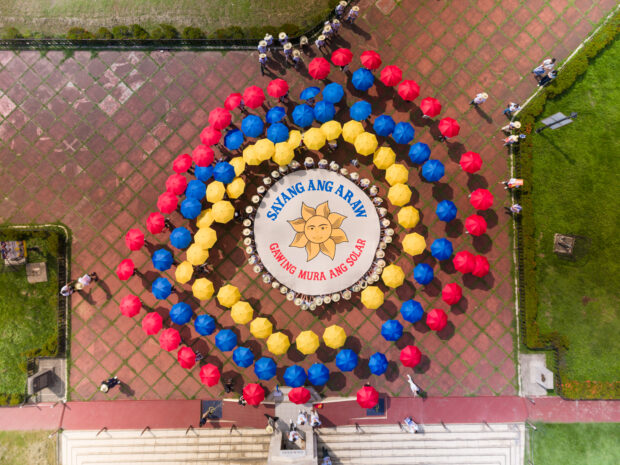
How much potential solar energy is wasted?
Philippine households combined consume an estimated 57,500 to 100,000 Megawatt-hours (MWh) daily, a requirement that could easily be supplied by solar power.
A study tool developed by the Institute for Climate and Sustainable Cities (ICSC) revealed that rooftop solar potential across the country’s major urban areas and economic zones alone may yield 106 gigawatts (GW).
“Today, only about 0.50 percent of this potential has been tapped, with many rooftops still idle despite their capacity to produce electricity,” ICSC said.
Who benefits from expensive electricity in the Philippines?
The Philippines consistently ranks as having the second-highest electricity cost in Southeast Asia (just behind Singapore) and the third-highest in all of Asia (generally trailing Singapore and Japan). Average residential rates in the country typically hover around P12 to P14 per kilowatt-hour (kWh) depending on the season and specific provider.
Advocates point to lack of government subsidy and total privatization of the country’s energy sector as main culprit. Every cost and expense from generation to distribution are passed directly to the consumers, including so-called system losses due to pilferage.
The Philippines also heavily depends on imported coal and oil as fuel for its power plants, all of which are owned by billion-peso corporations. This leaves local bills vulnerable to global supply shocks such as the Middle East war and fluctuations in the Philippine Peso/US Dollar exchange rate.
The energy sector’s total gross value and assets in the Philippines is a P3.3-trillion (Dh200 billion) industry, according to the Department of Energy Philippines. It is so powerful it dictates its own pricing through its Wholesale Electricity Spot Market scheme that changes according to factors given by industry players.
How much does a rooftop solar installation cost?
A standard residential rooftop solar setup in the Philippines can easily cost upwards of P100,000 (Dh6,000), an investment that equals several months of salary for many minimum-wage workers. But many families are ready and willing to give it a try, especially if made easier by easier government permitting programs and low-interest financing options.
Unlike countries such as Australia or parts of the US that offer tax credits, feed-in tariffs, or no-interest loans to spur residential adoption, the Philippine government provides minimal financial incentives to households. National policies have historically catered to large, utility-scale developers rather than individual, decentralized power generators.
But the campaigners point out that these are secondary considerations as the biggest hurdle – supply – is not a problem in the Philippines. Philippine Solar and Storage Energy Alliance (PSSEA) President Ping Mendoza highlighted that the country’s technical rooftop solar potential is nearly six times greater than the current national peak electricity demand.
“Imagine all the energy we need, falling from the sky every single day. Free. Independent from whatever one person, company, or country decides to provide for us or not,” said Mendoza.
The Makabayan Coalition of progressive lawmakers have a pending bill for the installation of a million rooftop solar panels, but have yet to be discussed at the Philippine House of Representatives.