By Tomas T. Talledo
The joy of tomfoolery
I am making a fool of myself with this essay. I fool myself into believing that I can write about
poetry with claimed authority when I was disciplined under a no-joke study of politics and sociology.
Those are two nose-bleed sub-sciences of the social and not just some cotton candy poetics of the personal. Perhaps what I have in excess is wishy-washy self-conceit because I wrote and published what is considered as poem or binalaybay. Yet I am aware of the strong dislike of memetic arts by those hard-core philosophers. Plato bans poets from his work, The Republic, as artificers of representation when real knowledge can only come from presentation of brute reality. In ascertaining the hows of knowing (i.e., epistemology), for him pedagogical presentation is far superior than representation.
What I have is some foolish daring when foolishness is located in a transversal angle with respect to audacity. And my audacity, my bravery, is foolishly directed against poets’ bankrupt metaphysics of creation – the laughable analogy that an oyster when irritated by a grain of sand vomits a sparkling pearl. The sweet masochism when “the oyster takes the pain it feels and turns into a rare pearl” (Antonia Storace)
My poetic labor is clearly against such grain. Since my labors – I like to believe – is part of that materialist and expressive energies that will collectively release suffering peoples like us from the realm of brutish necessity into the promise land of freedom, shared wealth and sovereignty.
I searched and found such expressive and liberative energies in the poems by revolutionaries Chou En-lai, Mao Tse-Tung and Ho Chi Minh. I read them as poets of exigent brute prose, as
revolutionaries who engaged in actual combat. They were revolutionaries who are poets and poets who are revolutionaries. In the later part, I comment on the poems of Servando Magbanua and Maya Daniel, the two poet martyrs in Panay Island, Philippines, of recent memory.
I borrowed the title my piece from my poem Songs of War Patriots (2011) collection of poems. The lines go this way – “Hear from us what is poetry/It’s the ashes of dead comrades/Sounds of arms in howling plains/For/When verses are comraderies –/Of people and fighters in soldiery/Then death awards sublime beauty/To us/An encounter with the enemy is poetry./When scaling the mountain’s skull/We drink danger heartily/So sweetly/We march where our bodies may fall/Poetry is an encounter with the enemy.”
Chou En-lai, Mao Tse-Tung, Ho Chi Minh
Chou En-lai’s site of meditations in and of history. From IN QUEST. Poems of Chou En-lai. Trans. by Nancy T. Lin, 1979.
Four poems are subjects of this reading here. Poems by En-lai written while on meditative pause at Arashimaya and Maruyama parks of Kyoto, Japan. Then until now the airs of nostalgia, ephemeral beauty and equanimity flow around Kyoto as City of ancient charms. And the poet En-lai can only succumbed to these charms.
He wrote “Arashiyama in the Rain (AR), April 5, 1919,” “Arashiyama after the Rain (AAR), April 5, 1919,” “Maruyama Park (MP) April 5, 1919” and “Fourth Visit to Maruyama Park (FVMP) April 9, 1919.” Having veered away from classical form, he decided in favor of free verse as expression. En-lai was then in Japan like those young scholars who were studying, reflecting, reimagining those troubles that rocked their homey middle kingdom.
Picture him sitting by lonesome, his eyes fixed straight with brows tensed in seriousness. His body sensed the whole surroundings. He wasn’t there for fun, he was there locating himself in the broad canvass where personal biography intersected with history. At moment of greatness and humility before heroism, he was.
While in Arashiyama park, he was jolted by “[t]ruths unnumbered/Implicit in the world’s manifold, /The more search, the more haziness” (AR, lines 10-13). There was no hopeful view of 1919 Chinese homeland when the Republic set up by Sun Yat Sen was dismantled only to wind back in warlords’ status quo ante. Looked like, felt like history was marching backward. “O, the plaster ornaments of religion, feudal ethics/and outworn arts and letters;/The frustrating doctrines that are still being bandied/about on so-called belief, sentiment and aesthetics!” (AAR, lines 10-13).
Keen observers cannot be absolute about the linear, serial and ascending trajectory of history. The normal span of human life is short as to witness history’s twists and turns and to grasp its final unfolding. Thus, often the dark presence of bleak vision. Thus, bourgeois pessimism.
But while inner cynics bleat that only uncertainty is certain; dialectical thinking hints that zigzag may not be the shortest route, yet often the most efficient. Ever a revolutionary optimist Mao Tse-Tung, En-lai’s comrade said, “[t]he world is progressing, the future is bright, and no one can change this general trend of history” (Little Red Book).
Meditation, a poetic style hankers a longing for “what could have but really never been” can also be encountered in Jose Rizal’s “To the Flowers of Heidelberg” (1886). His great longing that if only the freedom of sciences and arts of Heidelberg can be transported to the colonized Filipinas, flowers are opening portals of deliverance. “Carry, carry, O flowers, /my love to my loved ones, /peace to mycountry and its fecund loam,/faith to its men and virtue to its women, /health to the gracious beings/that dwell within the sacred paternal home.”
To be located somewhere far away, poetic meditation of home is an achingness, is pangungulila, is pagkahidlaw. A yearning to be in an ideal or idealized homeland, an irresistible human longing for the Communist Horizon.
Not the China of 1949 yet, thus 19 years old En-lai angstily wrote, “Nine days in Kyoto/Has gained me a full draft of its bittersweet” (FVMP, lines 11-13). Meanwhile, there is this reply from Mao to Comrade Kuo Mo-jo from 10 More Poems of Mao Tse-Tung, Eastern Horizon Press, Hongkong, 1967.
In this collection there are two poems titled “Reply to Comrade Kuo Mo-Jo” as objects of my comments. The poem dated 17 November 1961 is in lu shih form of eight lines with seven characters per line (p. 14). Inspired by the 16th century novel, Journey to the West, characters and actions are from this classic tale. This is Mao’s reply to Kuo Mo-Jo’s poem, “On seeing the Monkey subdues the Demon” also in lu shih form, that referred to same novel. Cleary this is an exchange of the two poets to demonstrate their mastery of Chinese classic tales and poetic forms. Kuo Mo-Jo’s poem though underscores the longish practice of patience as revolutionary virtue.
Mao on the other hand reminds and warns Kuo Mo-Jo that even as the initial threat was forcefully dissipated: “The Golden Monkey wrathfully swung his massive cudgel, /And the jade-like firmament was cleared of dust”/. Yet and yet, “Today, a miasmal mist once more rising.”
The project of national liberation is not a one-shot deal. The political modality to victory in short remains protracted.
The other “Reply to Comrade Kuo Mo-Jo” poem (p. 20) in tzu form can be sang to the melody of Man Chiang Hung. It’s last line, “Seize the day, seize the hour!” is most familiar and is often quoted as political call even by those who do not know Mao was its author.
Kuo Mo-Jo’s tzu poem to which Mao replied (p.31) tries to capture China’s lot in the 1960s. Those were years when the nation grappled with the problem of food security. Mass mobilization of the people, the potent mass movement, not bureaucratic technocracy, was the means to arrive at solution. And Kuo Mo Jo in his poem disputes imperialists’ nasty depictions that Chinese socialist reconstruction as disaster. More often revolutionary success in the East is Western corporate press favorite pet aversion.
Mao’s poetic repartee affirms their national will to triumph over adversities by slamming down those debasements the Chinese socialist reconstruction had achieved so far and the projected gains. The imperialists and enemies of the Revolution are deluding themselves: “Ants on the locust tree assume great nation swagger/And mayflies lightly plot to topple the giant tree.”.
The poetic allusions Mao employed here are already too familiar to literate Chinese audience. And Comrade Kuo Mo-Jo simply serves as Mao Tse-Tung’s literary provocateur and interlocutor.
Poetry can be a delightful encounter with a cherished adversary.
Uncle Ho’s Prison Diary
From Ho Chi Minh’s Prison Dairy, 1978, Ohio University Press, Trans. by Christopher Jenkins, Khanh Tuyet, and Huynh Sanh Thong, Ed. by David G. Marr
That prisons are “graduate schools of revolution” (Preface) is poetic blowback fascists cannot appreciate ever since Antonio Gramsci, Jose Maria Sison and uncle Ho Chi Minh graduated with high honors among countless alumni.
Prisons’ claustrophobic walls became the nurturing cocoon of ideologues’ further tempering of will and conviction. As revolutionary seedbed of prisoners of conscience, cold calaboose was their sterling practicum-qua-lyceum. Uncle Ho writes, “Using my tears as for ink, I turn my thoughts into verse” (Autumn Night).
Uncle Ho wrote one-hundred thirty-three quatrains in fourteen months shuttling back and forth in thirty jails at Kwangsi, China. And he played with subtle, nay, almost innocent imageries to hide passwords of clandestine views to comrades.
His creativity burst forth under extreme danger while accomplishing inter-Party alliance outside
Vietnam. And the fruits of his incarceration was this autopoetic texts in the classic Chinese Han script of seven syllable-to-a-line quatrains. Historian David Marr qualified Ho’s prison diary as poetry of “most fundamental aspects” aware as he was of the extraordinary context of creation.
Poet as revolutionary or revolutionary as poet is sui generis creator of what ought to be. For a poet Uncle Ho’s mushy sentiment was alchemical to the project that is seriously historical. His senses for instance painfully longed for balmy nature: “All over the mountain I hear the songs of birds,/And the forest is filled with the perfume of spring flowers.” (On The Road).
Yet such same alchemy brewed revolutionary delight: “They used to sing of nature’s charms — hills, streams, mists, flowers, snow, moon and wind./Today a poem must have steel./A poet must learn to wage war.” (On Reading the “Anthology of A Thousand Poets”)
Chou En-lai’s nostalgia is history’s projected Communist future, the valid human longing for what ought to be. For not all nostalgia is backward looking or reactionary, part of it is forward-looking or revolutionary. It can even be submitted that nostalgia is the yet-to-be-fulfilled utopia.
Already acknowledged by philosopher Frederick Jameson: “it is difficult enough to imagine any radical political programme today without conception of systematic otherness, of an alternate society, which only the idea of utopia seems to keep alive.” (The Politics of Utopia, NLR | 25 Jan/Feb 2004)
The poetic repartee of Mao with Kuo Mo-Jo resonated with China’s period of transition to Socialism in late 1950s and early 1960s along with the county’s First Five-Year Plan. Kuo Mo-Jo may have sounded overly optimistic though subdued by Mao’s studied realism. With Sino-Soviet dispute on strategy of economic development going on; the divide between the two camps demarcated Soviet’s preference for high-industrial technocratic approach and China’s favored collectivization, self-reliance with active political guidance of the Communist Party. The repartee evinced Mao’s affirmation of and trust on the historical creativity of the Chinese masses.
Indeed prisons are “graduate schools of revolution” and Ho Chi Minh was and still is the mentor without equal of revolutionary experience for the Vietnamese. The lessons imparted resulted into the final expulsion of arrogant colonizer-imperialists. The defeat of foppish French troops in 1954 at the Battle of Dien Bien Phu was commanded by General Vo Nguyen Giap, uncle Ho’s student colleague.
The fall of Saigon in 1975 that ultimately kicked-out American forces was framed by Ho Chi Minh’s application of people’s war strategy. The memory of him and his inspiration had delivered the end of imperialist occupation of Vietnam.
Poetry of specificities in Panay Island
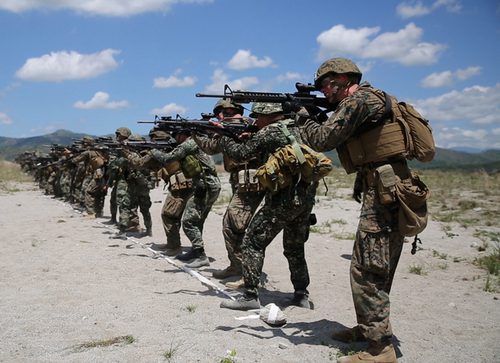
Finally, poetry out of imprisonment gave way to poetry of engagement. And now, I comment on two martyrs of Panay. They are poets Jose Percival Estocada, Jr. known by his nom-de-guerre, Servando Magbanua (1946-1986) and Felix Salditos more known as Mayamor Daniel (1988-2018). Both shared the poetic location far away from that cowardly choice that “pen is mightier than the sword”. Oh yeah! Both were revolutionaries as poets, both were poets as revolutionaries who simultaneously held both pen and armalite.
Both died of course in glorious death as martyrs of the Revolution since Poetry is a no-nonsense encounter with the enemy.
Servando Magbanua’s poem Eastward the Winds of Song (1980) tells the enthused guerrilla expansion movement to cover larger area. The poem captures the band’s boldness as they descended from Taganhin mountain of Tapaz, Capiz to the plain cane fields of Calinog and Bingawan towns.
Here fickle mortality is heartily acknowledged mixed with awesome fearlessness: the emotional topographic specificities of protracted people’s war in Panay Island.
“Fleetingly with yet a longing we cannot name/we look back at towering Taganhin majestic above/the rugged mountain districts and smile…” The poem closes, “‘Pasa bilis!’ our squad leader motions./ We hurry on with winged feet/our hearts throbbing wildly/as eastward the winds of song/draw us nearer, nearer/to the land of the haciendas…”
During 1986 peace-talks, ceasefire interregnum under Cory Aquino, while on duty as a regional NDF spokesperson, state forces pumped bullets into the heart of Servando Magbanua.
In the highlands where Tumandok epics are chanted, where he alchemically bonded the loves, struggles and deaths of fighting comrades into poems, Mayamor Daniel played the role of a human transducer of revolutionary energies. A poet like a technologic device who converts energy from one form to another. That happens when enchanted nature is wielded as beauteous weapon of revolution.
Pandungon (2002) is Mayamor’s poem about safe, restful hiddenness somewhere at the bank of Aglupacan river, Tapaz, Capiz. He described the place with high walls of rocky formation that is sacred to Tumandok’s ancestral epic heroes. Though already desecrated, “This temple stood,
timeless/the sheltering rock-fold desecrated/and your image etched on the walls abandoned, /the waters of Aglupacan river beneath, /ever-murky even on fairest summer –/no longer mirrors your countenance.”
And yet tenacious will stays, “Hear gods of long ago, /there are cries beyond this deafening silence,/hear the human voices and anguish of your people/as the sands at the river’s water-edge/bore the intruding footsteps/of merciless, fascist war robots/from Camp Peralta/to deliver harm and death/against our existence and our living past.”
Topographic hiddenness is clandestinity since the revolutionary army blends with the natural elements like flora and fauna, they can shift temporal aims conscious of the seasons, moving fluidly outside mechanical clock-time in whatever terrain. And like heroes of Tumandok epic, nature was and is their reliable ally in Inaway Banwa, in Protracted People’s War. The on-going real, brutal war had ended the life of Mayamor Daniel along with the victims of August 15, 2018 Antique massacre.
Kindred to “aha!” epiphany poetry is Chou En-lai’s historical meditation, poetry is Mao Tse-Tung’s keen repartee, poetry is Ho Chi Minh’s tough resolution and, at Panay Island, poetry is an encounter with the enemy. #