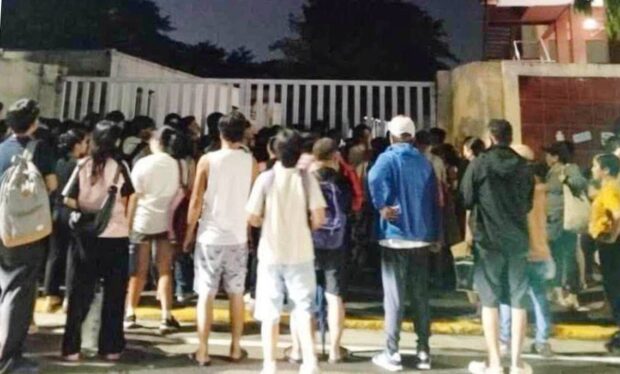
The over 23 million grade school and high school students throughout the Philippines are confronted with a new concern as they went to school on Tuesday morning: gun shooting. On Monday, two male students (aged 15 and 14) opened fire at San Jose National High School in Tacloban City, killing three and injuring several others.
The parents expressed alarm, prompting Philippine President Ferdinand Marcos Jr. to order a thorough investigation into the incident.
Various initial reports were quick to call the incident as “rare,” perhaps comparing it to the horror that had been occurring in the United States of America with dreadful regularity.
But is violence in Philippine schools really rare? What are the factors that lead to extreme acts in what should be safe spaces for children? What should Philippine authorities and parents do to prevent violence in schools?
Is school violence really rare?
On the day that the Tacloban shooting happened, a high school student in Sta. Barbara, Iloilo province was arrested for punching a school mate with brass knuckles. The victim was knocked out of consciousness when hit in the temple. The perpetrator is under custody by social welfare officials.
In Cavite City, two high school students engaged in a fistfight that led to a stabbing. The victim sustained three knife wounds on his torso. He was taken to a local hospital for treatment and currently recuperating at home. The perpetrator is also under custody.
Last June 16, seven Grade 5 pupils of Bethel Academy in Gen. Trias, Cavite, were injured after they were reportedly attacked by a Grade 8 student with a kitchen knife.
Social media is also rife with videos of Filipino schoolchildren engaged in school gang brawls, many of whom are even wearing school uniforms. Both male and female students are involved. Long acknowledged as a problem, the country’s public school system seems powerless to address the phenomenon.
Is bullying a factor?
Philippine National Police (PNP) spokesperson Colonel Allen Rae Co said one of the perpetrators in the Tacloban school shooting claimed to have been bullied that led him to commit the act.
The country’s education department admits to rising incidents of bullying in schools. In Metro Manila alone, the agency reported 2,500 bullying cases for academic year 2024–2025, up from 2,268 cases the previous school year. Nationwide data indicates that the Philippines continues to struggle with increasing incidents of bullying, surveys showing that seven out of ten Filipinos have experienced bullying in school or online.
The Department of Education (DepEd) implements an anti-bullying program mandated by a special anti-bullying law that took effect in 2013. The law orders all public and private basic education schools to establish comprehensive, localized anti-bullying policies, intervention programs for both victims and bullies, and strict reporting protocols.
But bullying cases remain grossly underreported by school authorities, perpetuating the belief that such is part of the student’s growing up phase. Such neglect may lead to fisticuffs, stabbings and copy-cat shootings.
s insecurity,

Other reasons for school violence
Despite stringent laws on gun ownership in the Philippines, the two Tacloban school shooters were able to get hold of a pistol owned by a police officer and a revolver owned by a security guard. Authorities said that police officer, an aunt of the younger shooter, is suspended from active duty pending investigation, while the security guard has yet to be identified.
Violent online content may be another factor that must be investigated. The younger shooter was wearing a KMFDM shirt that stands of the phrase Kein Mehrheit Für Die Mitleid when arrested. It is a name for the German band that loosely translates as “No Sympathy for the Majority” with a branding that may be misconstrued as encouragement to commit violence. Shooters in Columbine High School in Colorado in 1999, Abundant Life Christian School in Wisconsin in 2024, UCLA in 2016, and Ball State University in Indiana in 2018 wore KMFDM shirts.
The police also said the younger shooter is addicted to violent online games, leading authorities to suspend said applications.
School conditions were also blamed why authorities failed to prevent the Tacloban incident. San Jose National High School only has one security guard overseeing 1,500 students of a school with multiple entrances and exits. Not all public schools in the Philippines have security guards due to fund limitations.
Government accountability
The Alliance of Concerned Teachers (ACT) called on the Marcos Jr. government to provide comprehensive medical, psychological, and psychosocial support to the victims, their families, and all members of the school community affected by the tragedy.
The group, however, cautioned against labeling the incident as “isolated,” saying the problem is deeper than admitted and is in fact systemic. ACT cited official reports that overcrowded Philippine classrooms, numbering to an average of 60 students, contribute to a diminished sense of safety among learners.
A San Jose National High School teacher said the elder shooter was “quiet, socially withdrawn,” and academically behind his expected grade level. “He is a loner. He does not mingle much with his classmates. He was also a repeater,” the teacher said.
ACT said students themselves report that overcrowded classes are often disorderly and marked by bullying, intimidation, and harassment. In contrast, smaller learning groups allowed learners to feel safer, more supported, and more comfortable participating in class.
“Government’s own findings show that overcrowding is not merely a learning issue but also a student welfare issue. When classrooms contain 50 or 60 learners, meaningful guidance, supervision, and intervention become far more difficult. Students themselves report feeling safer and more supported in smaller classes,” ACT national president and public school teacher Ruby Bernardo said.
The Philippine government allocated P1.34 trillion for the education sector this year, barely meeting the global standard set by UNESCO of 4% of a country’s gross domestic product (GDP). Education International, however, recommends 5% of the GDP. There remains a shortage of 150,000 teachers and more than 160,000 classrooms in the entire Philippines, however, ACT said. Thousands of schools remain without adequate guidance counselors, nurses, librarians, and psychosocial support personnel. There are only 2,400 guidance counselors in all of the country’s 45,199 public basic education schools.
The group stressed that anti-bullying programs, mental health services, guidance and counseling, and values formation initiatives cannot succeed when schools are chronically understaffed and underfunded. ACT said that children deserve schools where they are seen, heard, guided, and protected, requiring more than emergency responses after tragedies occur.
The group called on the government to substantially increase the education budget to address the shortages in classrooms, teachers, and support personnel that continue to undermine both the quality and safety of Philippine schools. A bigger education budget must be viewed as a sustained public investment in education and in the well-being of Filipino children, Bernardo said. # (Raymund B. Villanueva)