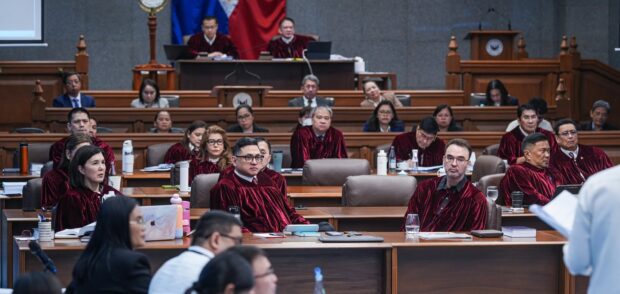
There was a moment during the fourth day of Vice President Sara Duterte’s impeachment trial when the Senate seemed less concerned with a televised death threat than with typographical errors.
A wrong date. A mistaken agency name. A missing document.
For hours, these became the battlefield. Meanwhile, the constitutional elephant remained standing in the middle of the chamber: What happens when the nation’s second-highest official publicly declares that she has arranged the killing of the President, the First Lady, and the former Speaker if harm should come to her?
That is the question the country expects the Senate to answer. Yet Day Four often felt like watching lawyers measure the bark while ignoring the burning forest.
The day’s lone witness, NBI Regional Director Atty. Jeremy Lotoc, formerly chief of the NBI Cybercrime Division, testified on the bureau’s investigation into the Vice President’s now-infamous November 23, 2024 livestream. The prosecution’s objective was straightforward: establish that rants made by the vice president were not reckless political metaphors but serious threats that crossed the constitutional limits of protected speech.
Lotoc explained that the NBI subjected the video to a rigorous digital forensic process—identification and preservation, collection and hashing, attribution and contextual analysis, and legal evaluation before referral to the Department of Justice. According to the bureau, the investigation concluded that the threats were “serious, real, and actual.” The NBI likewise considered Duterte’s earlier public statement expressing a desire to “behead” the President as part of a pattern demonstrating intent.
Perhaps Lotoc’s most significant testimony was not technical but constitutional. He declared that the statements no longer belonged within the protective mantle of free speech. To normalize death threats against the nation’s highest officials, he warned, would invite disorder and undermine the rule of law itself.
The defense changed tactics. Having spent previous trial days aggressively objecting to the admission of evidence, it allowed the testimony to proceed before attacking the witness’s conclusions during cross-examination. The defense argued that the NBI’s assessment was largely subjective, emphasizing that the supposed assassination order was merely conditional and floated the narrative that the Vice President was reacting to an alleged plot against her life, dubbed “Operation Romanov.”
Yet for all the aggressive questioning, the defense never truly dismantled the core fact confronting it: the words were spoken. Its closing refrain—that the NBI could not be impartial because it is under the DOJ, which in turn belongs to the Executive—sounded less like a legal rebuttal than a political talking point.
The day’s turning point came not from either legal team but from Senator-Judge Bam Aquino.
In a careful series of questions, Aquino cornered the defense into acknowledging that while it denied any actual hiring of a hitman, it did not dispute that the Vice President uttered the statements themselves. The exchange exposed the defense’s dilemma. If no hitman existed, was the Vice President merely inventing an assassination plot during a nationally broadcast press conference? Either way, the issue before the impeachment court remained one of judgment, responsibility, and fitness for office.
The prosecution gained an important concession. The defense, however, found itself advancing an argument that raised even more troubling questions about the conduct expected of the country’s second-highest constitutional officer.
Still, the prosecution was hardly spared embarrassment.
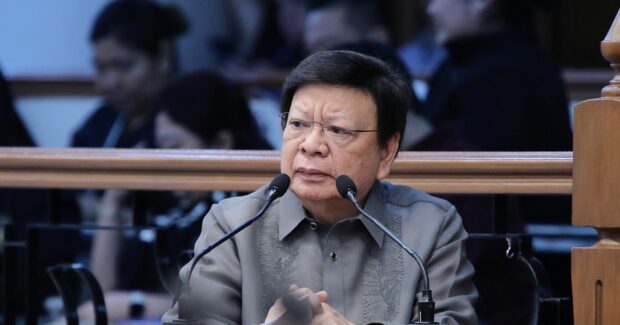
Senator-judges Imee Marcos and Alan Peter Cayetano subjected the NBI documents to close scrutiny and uncovered glaring errors. One affidavit referred to a subpoena supposedly issued weeks before the controversial press conference even took place. Another official document mistakenly referred to the Department of Education instead of the Department of Justice. Lotoc repeatedly described them as typographical mistakes, but the senators were unconvinced. In a case carrying enormous constitutional consequences, they rightly insisted that official investigations demand greater diligence.
These lapses provided the defense with ammunition to question the professionalism of the investigation, even if they did little to erase the substance of the Vice President’s own recorded statements.
Outside the witness stand, procedural disputes also surfaced over the scheduling of NBI Director Melvin Matibag’s testimony, with the Senate requiring documentary proof of his overseas commitment before adjusting the prosecution’s witness lineup. It was another reminder that procedure matters—but procedure should never overwhelm purpose.
That, ultimately, is the larger lesson of Day Four. It ultimately revealed two parallel trials.
The first may occupy lawyers. The second will define history. One was fought over typographical mistakes, documentary lapses, and procedural skirmishes. The other—far more consequential—asks whether the Republic can tolerate a public official invoking political assassination and still claim to embody the constitutional standards of honor, integrity, and public trust.
An impeachment court is not a criminal court. Its constitutional task is not to determine guilt beyond reasonable doubt but to decide whether a public official has remained worthy of the people’s trust.
The country is not watching merely to see whether an affidavit contains typographical mistakes. It is watching because it wants an answer to a far more profound constitutional question: what does public trust require from those who occupy the highest offices of the Republic?
No typographical error can erase words spoken before the nation. No procedural maneuver can substitute for constitutional accountability.
When the Senate finally casts its vote, Filipinos are unlikely to remember who misspelled an agency or entered the wrong date on an affidavit. They will remember whether their senators answered the only question that truly mattered: not whether the paperwork was flawless, but whether the Constitution itself was faithfully defended. #