Which among 11 Southeast Asian countries are more likely to weather the threat of an energy crunch the best as the Middle East war prolongs? Certainly, it would be those that have their own domestic oil production, such as Brunei and Malaysia.
It will also be two other countries that have an impressive proportion of power generation from renewable energy sources: Laos and Myanmar. The two countries are least dependent on fossil fuel for their energy requirements in Southeast Asia. They are the region’s top producers of renewable energy, benefitting from their proximity to the southern Himalayas that feed their rivers in their respective northern areas.
Laos’ renewable energy, primarily hydropower, dominates its electricity sector, accounting for roughly 75% to over 80% of total generation. It is known as “Battery of Southeast Asia” as it exports electricity from these resources to its neighboring countries. The landlocked country targets 100% electrification by renewable energy by 2030.
As of 2023, Myanmar’s renewable energy—primarily hydropower—constitutes roughly 44% to 54% of its electricity generation. Even while racked with civil strife, Myanmar is aiming for additional 14% to 15% of its total energy mix to come from non-hydro renewables by 2030.
In 2024, renewable energy (including hydropower, solar, and wind) accounted for roughly 44% of Vietnam’s total electricity generation, with solar and wind alone contributing 13%. Hydropower remains the largest renewable source at 31%.
As of 2025, renewable energy contributes roughly 30% to over 40% of Cambodia’s total electricity generation, primarily driven by hydropower (approx. 25–44%) and increasing solar capacity (approx. 5–6%).
Dirty fuel-reliant
Renewable energy production is a weak 22% to 30% of the Philippines’ total electricity generation in 2024, with geothermal and hydropower being the largest contributors. It still relies heavily on coal for about 44%–60% of its power, aiming to increase the renewable share to 35% by 2030.
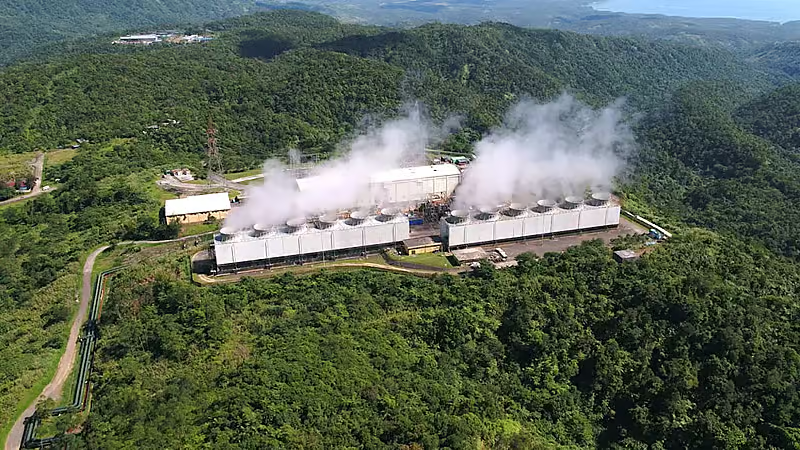
As of 2023–2024, renewable energy accounts for a small portion of Malaysia’s actual electricity generation, with hydropower being the primary source, followed by solar. While renewable energy represents roughly 20-23% of total installed capacity, its actual share in electricity generation is significantly lower. This is mainly due to the abundance of oil production in East Malaysia that provides fuel for its power plants.
In 2023, renewable energy accounted for approximately 15.98% to 19% of electricity generation in Indonesia, with hydropower (roughly 7-8% of total generation) and bio-energy leading the mix. As consistently the 3rd or 4th biggest coal producer in the world, its power sector remains dominated by coal, which provides over 60% of its electricity. Wind and solar power remain below 1% combined.
Thailand’s renewable energy contributes roughly 15% to 19.5% of its electricity generation in 2024, with fossil fuels (largely natural gas) still dominating. The country’s renewable mix is primarily driven by hydropower, followed by bio-energy and solar. Thailand has a target to increase this to 51% by 2037.
Because of its small size and lack of resources, renewable energy makes up a small portion of Singapore’s electricity generation, estimated at approximately 4%. This is predominantly generated through domestic solar photovoltaic (PV) systems. Under the Singapore Green Plan 2030, this share is targeted to rise to 40% (via imports and domestic renewables) by 2035.
Renewable energy generation in Timor-Leste is very low, accounting for approximately 0.20% to 0.37% of total electricity generation as of 2021. The country remains heavily reliant on imported diesel for power, with solar photovoltaics representing the largest share of the small renewable energy sector.
Because of its high oil production, Brunei does not seem to bother with renewable energy generation at the moment, with approximately 0.05% to 0.09% of total electricity generation as of 2022–2023. The country relies on fossil fuels (natural gas and oil) for over 99% of its power, but aims to reach a 10% renewable energy target in its electricity mix by 2035, focusing on solar power.
How Southeast Asia compares to East Asian countries
While Laos and Myanmar’s economies do not compare with the giants of East Asia, their renewable energy compare favorably.
Japan’s renewable energy is only 22.8% to 22.9% of its total electricity generation.
South Korea generates approximately 9.64% of its electricity from renewable sources, way behind the global average of 30%.
China’s super-economy is powered by renewables by as much as over 60%.
Renewable energy in Taiwan generated approximately 9.5% to 13.1% of the nation’s total electricity as of early 2025, according to varying reports. # (Raymund B. Villanueva)