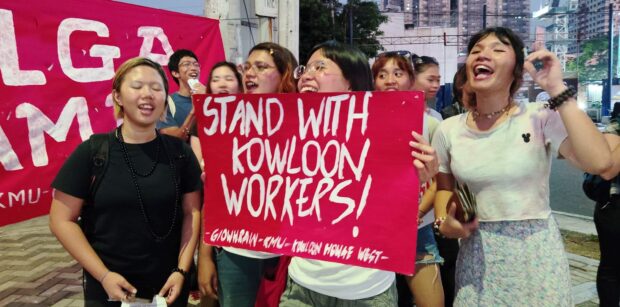
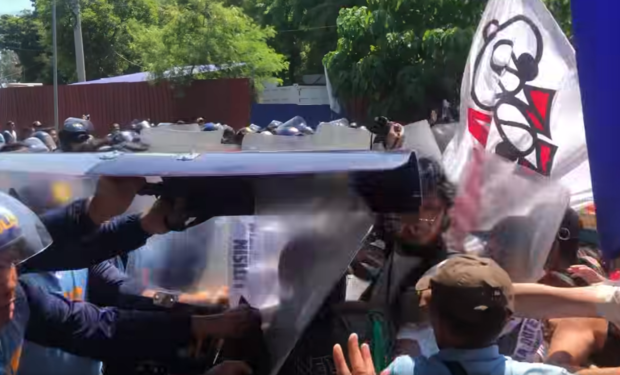
Instead of the traditional salary increase announcement by the President, workers were greeted by barbed wire and phalanxes of police offers on International Labor Day in Manila on Friday, May 1. Near the US Embassy, fire trucks were ready, raring to blast protesters with water jets, which they did even when the rally was about to end. They spun the yarn about a policeman’s phone allegedly snatched by an activist without mentioning the fact that the officer was an intelligence officer in civilian clothes taking videos of the protesters.
Earlier, thousands of workers marched on the streets of Manila towards Malacanang Palace to commemorate but were met with blockades. NCRPO director M/Gen. Anthony Aberin told reporters it was “never” their intention to prevent the rally where it had always been held – at Mendiola Bridge. It is totally lost on the police that they violated the workers’ right to peaceably assemble and air their grievances with the government.
Instead of responding to demands for salary increases amid the inflationary effects of the war in West Asia on the Philippines, President Ferdinand Marcos Jr. chose to issue a superficial homage to workers while remaining silent on their main demand of wage adjustments.
Silence amid a raging war
The May 1 wage hike announcement tradition was actually started by the current president’s father, Ferdinand Sr. in 1976. That year, he issued Letter of Instructions No. 426 setting a minimum wage increase of P10 that could be worth hundreds of pesos in today’s money.
In his first Labor Day as president in 2023, Ferdinand Jr.’s government approved a P40/day wage hike in the National Capital Region (NCR). In 2024, he ordered the regional wage boards to minimum wage rates within 60 days to adjust to inflation. A P35 daily increase was eventually ordered in July that year. A P50/day increase was also approved in 2025, bringing the minimum wage of private sector workers to P695 per day (Dh41.70) in Metro Manila.
The wage boards for other regions of the Philippines approve differing amounts, justifying that a worker needs less to survive the father one is from Metro Manila. In the Bangsamoro Autonomous Region in Muslim Mindanao, daily wage is pegged at a paltry P411. It is befuddling reasoning to non-government economists as prices of commodities are more expensive in the provinces.
On the year that the country is in danger of hyperinflation due to the war in the Middle East, there is nothing heard from the president. He thus continues what his predecessor Rodrigo Duterte started in his administration of publicly paying respects to workers but not committing to just wage increases.
Unprecedented crisis
The Philippine peso is currently worth P61.32 per every US dollar, the weakest in had been in history. This makes it harder for the country to deal with the ongoing oil crisis brought about by the hostilities in the Middle East. Already, it is buying crude oil at USD126 per barrel, the highest in the last four years.
In the country’s next fuel price cycle next Tuesday, the energy sector will again impose hefty price increases across all fuel types, breaking the three-week streak of substantial decreases in diesel prices as Pakistan tries to broker a ceasefire between aggressors US and Israel with Iran.
The Department of Agriculture also announced rice price increases in the coming weeks, conservatively predicted at P62 per kilo from an average of P57 last month.
Power rates have also shot up as electricity distributor Meralco announced a rate increase of P.55 per kilowatt hour, yanking the overall rate to P14.35 per KWh from P13.82 in March. The announcement came just as electricity requirements have been increasing due to the onset of summer.
Former Central Bank of the Philippines deputy government Diwa Guinigundo revealed on Thursday that the Philippines is looking at a staggering 6.4 per cent inflation rate in April, largely due to the war in the Middle East.
Family living wage
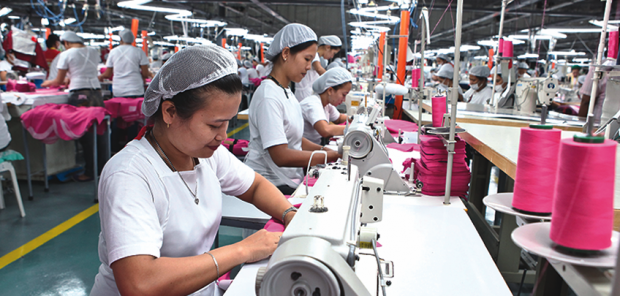
Minimum daily wage in the NCR in the Philippines is currently pegged at P695 for non-agricultural workers and P658 for agricultural, retail and service workers. This is 44.4 percent less than the recommended family living wage of P1,250 (Dh75) in Metro Manila, the bare minimum for a family of five to have a roof over their heads and food on the table.
It is not only the government that remains stingy on wage issues. Business groups such as the Employers’ Confederation of the Philippines as well as various chambers of commerce have consistently opposed all talk of wage adjustments, even in the worst of times. Aside from ignoring calls for substantial increases in wages, Philippine laws also allow businesspersons to do away with the minimum wage requirements if they have 10 workers or less. The employers then keep workers on perpetual irregular status to prevent them from paying minimum wage and other benefits.
Government workers are also demanding salary increases, saying entry level wages for licensed professionals such as teachers and nurses must be P50,000 (Dh3,000) per month and P30,000 (Dh1,800) for non-licensed employees. Save for the military and the police, this long-standing demand had been ignored.
What Marcos Jr said
President Marcos in his message acknowledged current difficulties brought about by the hostilities in West Asia. “As we face changing economic pressures, rest assured that this administration stands firm in defending the dignity of every Filipino by creating more and better jobs, boosting worker protection, and broadening pathways for all to succeed,” he tepidly said in a statement issued by the Palace. Nowhere in the rest of his statement does it say that just wages will be paid Filipino workers despite his acknowledgement that the Philippine workforce carrying the weight of the country’s future.
The Department of Labor and Employment meanwhile announced that as many as 115,000 positions are being offered in over 90 job fair sites across the country. With over 2,200 participating potential employers, the job fairs are offering positions in manufacturing, wholesale and retail, business process outsourcing (BPO), construction, and accommodation and food services. The department, however, is silent on whether the jobs being offered are regular, contractual or seasonal.
A huge 42 per cent of the nation’s work force is employed in the informal sector. Non-regular workers — including contractual, project-based, seasonal, and agency-hired — representing roughly 45 per cent of total employment. Government itself is one of the biggest practitioners of contractualization in the country. Most of them would be underpaid even by minimum wage standards.
With no mention of wage increases and regularization of their status as workers amid the grinding effects of a raging war in the Middle East, this year may be the worst Labor Day in the Philippines in recent memory. # (Raymund B. Villanueva)