Descendants of Don Isidoro Ramirez, hanged as a brigand by the colonial American regime, are fighting to have history corrected. More than a century later, the Municipal Council of Bangar however refuses to acknowledge his martyrdom.
By Mark Christopher D. Ramirez
As a descendant of Don Isidoro Ramirez, the story of his life and untimely death resonates deeply within me. It is not just a tale of a man unjustly accused and executed, but also a poignant reflection on the sacrifice, loyalty, and patriotism that my great-grandfather embodied. Isidoro’s life was one of service to his country, his community, and his family; but it was marred by a tragic fate that has, until now, been clouded by misjudgment and historical neglect. His death is a stark reminder of the complexities of war, the distortion of truth in the name of political agendas, and the enduring fight for justice and recognition.

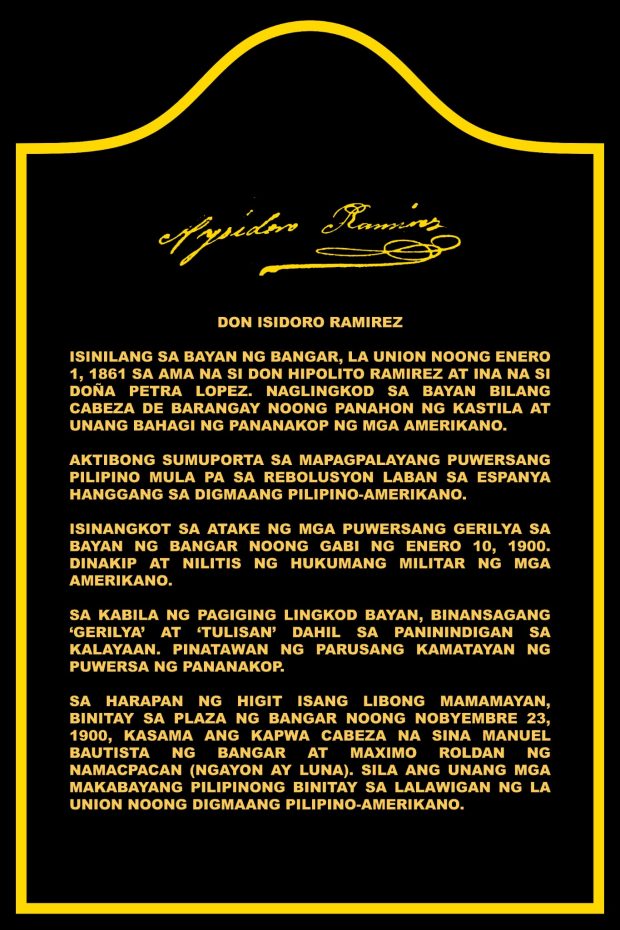
Born in Bangar, La Union, on January 1, 1861, Isidoro grew up as a humble yet dedicated public servant. He served his community as a Cabeza de Barangay and a member of the Municpal Council, contributing to the welfare of his town and its people. But as the Philippine-American War unfolded, the line between loyalty to one’s country and loyalty to one’s rulers became dangerously blurred. Like many Filipinos, Isidoro supported the resistance against American occupation, standing with the guerrillas who fought for the nation’s freedom. Yet, it was this very support that led to his martyrdom.
On January 10, 1900, the town of Bangar was attacked by revolutionary guerrilla forces, and several town officials, who were known supporters of the Americans, were killed in what was deemed a violent ‘insurgent’ attack. The Presidencia of Bangar was raided by the freedom fighters and the town’s coffers were confiscated.
Isidoro was implicated in this attack. The American military, eager to suppress the resistance, accused him and his fellow Cabezas Manuel Bautista and Maximo Roldan, of being co-perpetrators. The accusations were based on flimsy circumstantial evidence. Despite his insistence that he was at home with his family that night, he was sentenced to death by hanging along with his co-accused, and they were executed publicly in the town plaza on November 23, 1900 – the first Filipinos hanged in La Union at the height of the war.
The trial was an embodiment of the miscarriages of justice during the Philippine-American War. There was no solid proof linking my great-grandfather to the crimes he was accused of. The testimonies presented were based on suspicion and personal biases rather than facts. Yet, in the eyes of the American military, his fate was sealed. The narrative that painted him as a villain — a murderer and thief — was much easier to sell than the truth of his loyalty and patriotism.
More than a century after their unjust deaths, I still feel the weight of his story — of his sacrifice for a cause he believed in — pressed upon my heart. Isidoro, a humble man who had devoted his life to public service and the well-being of his community, was not a criminal, nor was he a traitor. His only crime was his unwavering support for the Filipino resistance against the oppression of foreign colonizers. His dedication to the fight for independence was shared by countless others who, like him, paid the ultimate price for the freedom we now enjoy.
In truth, the attack on Bangar was carried out by guerrilla fighters from General Manuel Tinio’s brigade, and not by Isidoro Ramirez and his co-accused. The attackers were brave Filipino soldiers fighting for their country’s freedom, yet the American military needed scapegoats to justify the bloodshed. Isidoro’s name was one of those tragically dragged into the web of lies spun by an empire eager to justify its conquest. His execution was a travesty, and the truth of his innocence has been obscured for far too long.
As a descendant of Don Isidoro Ramirez, I find myself in a position where I must carry the torch of his memory, to fight for the truth that has been buried with him for over a century. It is not just about seeking justice for him as an individual, but about restoring honor to the many Filipinos who were wrongfully accused and executed during this dark chapter of our history. The Philippine-American War was a battle for independence, but it was also a war against truth and the forces of historical amnesia.
Our family implored the National Historical Commission of the Philippines (NHCP) as well as the Local Government and the Sangguniang Bayan of Bangar (who are the proud inheritors of the freedoms fought for by our ancestors) to finally recognize my great-grandfather’s rightful place in history. It is time to acknowledge the sacrifices of Isidoro Ramirez and the other patriots who were executed in Bangar during those tumultuous years. We believe this act of recognition not only serve as a tribute to his life and sacrifice but also as a testament to the enduring spirit of Bangar and the Filipino people.
This recognition would not only serve to right a historical wrong but also contribute to a greater understanding of Bangar’s role in the nation’s fight for independence. It would also foster a sense of pride among the people of Bangar, reminding them that their town, their ancestors, were part of a larger narrative of resistance, resilience, and the fight for freedom.
Isidoro Ramirez was a man who dedicated his life to the service of his people and the cause of Philippine independence. His death, though tragic and unjust, should not be forgotten but celebrated as an integral part of our national history. His story is not one of despair but of hope, a hope that one day the truth will prevail and those who fought for freedom, even at the cost of their lives, will be remembered and honored. #
= = = = = =
Following Bangar Municipal Council’s refusal of the Ramirez clan’s petition to recognize Isidoro as a patriot, his descendants linked up with a descendant of another freedom fighter, Philippine Revolutionary General Manuel Tinio to press for the martyr’s recognition as a hero.
Last November 12, the author joined ACT Teachers’ Representative Antonio Tinio in filing House Resolution No. 461 urging the House of Representatives, through the Committee on Basic Education and Culture, as well as the National Historical Commission of the Philippines (NHCP) and the local government of Bangar, La Union, to honor the late Isidoro Ramirez and all the martyrs of Bangar during the Philippine-American War.