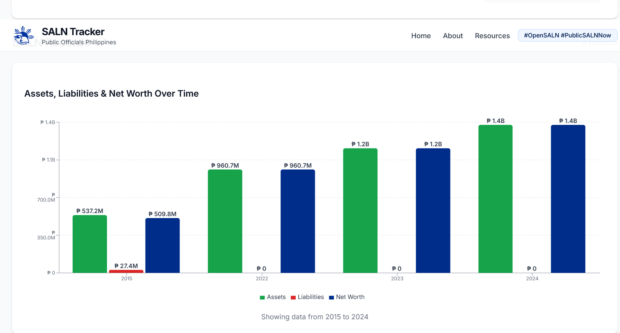
Philippine President Ferdinand Marcos Jr. and First Lady Liza Araneta-Marcos’ conjugal wealth jumped by 37.22 per cent from P960.7million at the start of his presidency in 2022 to P1.4 billion in 2025.
According to the Statement of Assets, Liabilities and Net Worth (SALN) the couple recently jointly declared, their total assets are worth P1.457 billion as of December 2025.
Based on an appraisal by the firm Cuervo Appraisers, Inc., the couple’s real properties had a total fair market value of P1.029 billion while their personal properties were valued at P427.419 million.
The appraisers also reported that the Marcos’ personal properties include investments worth P178.6 million, paintings valued at P84.8 million, cash holdings of P98.7 million, and jewelry worth P26.4 million.
They also declared 12 motor vehicles, including a 2023 Mercedes-Maybach S680 valued at P10.5 million and a 2023 GMC Yukon Denali XL priced at P9.5 million.
The first couple said they have no liabilities.
President Ferdinand Marcos Jr.’s annual salary as president is approximately PHP 5.54 million. His wife derives income as a law professor.
His father, former president Ferdinand Marcos Jr., was the richest president in Philippine history, with an estimated wealth of US$10 billion allegedly accumulated through corruption.
Marcos presides over a country the World Bank classifies the as a lower middle-income economy, with an average annual family income of P353,230.
Rich president, poor country
The classification, however, is strongly contested by independent Philippine economic think-tank IBON Foundation that declares the Philippines as a “sluggish and non-inclusive economy.”
In a report earlier this month, IBON said latest Philippine gross domestic product (GDP) figures show there are over 14 million poor families in the country while up to 3 million more vulnerable families may join them due to the administration’s “business-as-usual stance and largely performative responses” to the effects of the Middle East war.
“Inflation tripled in just two months, from 2.2% in February to 7.2% in April; 357,000 jobs were lost between February and March, and now economic growth has slowed to 2.8% in the first quarter of 2026,” IBON reported.
“Rapidly rising prices, worsening joblessness, and slowing growth are a clear stagflationary pattern that bears down the worst on tens of millions of poor and vulnerable households,” the independent economists added.

On Monday, the Philippine peso dove to another record low on Tuesday, trading at P61.79 for every US dollar, or P16.81 to the dirham.
IBON said the Marcos Jr. presidency has completed a stagflationary (stagnation and inflationary) hat trick: soaring prices, worsening jobs and slowing growth. # (Raymund B. Villanueva)