By Sarah Raymundo
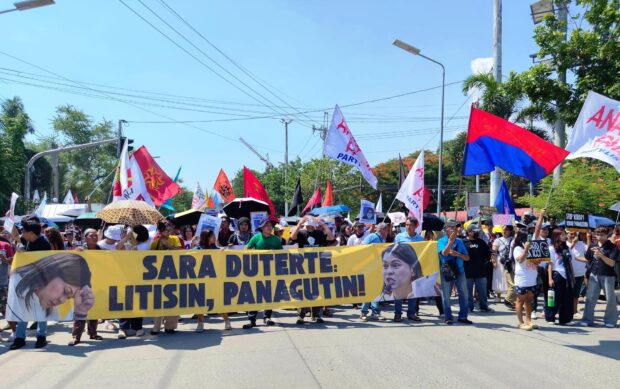
Cebu-based progressive organizations hosted an all-day Counter-ASEAN (Association of Southeast Asian Nations) Summit that extended into the early evening at the University of the Philippines-Cebu on Friday. Classes and work have been suspended since May 6, with nearly a hundred police officers gathered outside the university—serving as the primary audience for the outdoor demonstration. Earlier today, Greenpeace environmentalists were arrested for staging a picket at the summit venue in Lapu-Lapu City. All these while the 48th ASEAN Leaders’ Summit was in full swing in this city.
Urban poor communities were evicted from their homes and temporarily billeted in hostels, while those who remained saw their settlements shrouded under massive tarpaulins—to prevent Asian ministers from “discovering” that poverty remains endemic in this host city and country.
The Counter-Summit kicked off with a press conference featuring speakers from progressive groups and institutions like the IBON Foundation, followed by a forum titled “Imperialist Crisis and War: A People’s Alternative to the ASEAN Summit.”
I and my colleague, Prof. Enzo Diola, addressed the historical and political-economic dimensions of ASEAN, linking them directly to the deepening U.S. imperialist crisis and drive toward war. Youth from various organizations delivered incisive analyses on imperialist plunder and climate justice; revolutionary culture; public spaces; and education—each framed against the neoliberal assault on these fronts. We should be able to synthesize that discussion into an article.
In the meantime, the following are notes I prepared for the press conference.
Peace Summits and Missile Launches: What ASEAN Refuses to Name
As ASEAN leaders gather in Cebu under the theme “Navigating Our Future, Together,” we were told this summit is about peace, resilience, and regional cooperation.
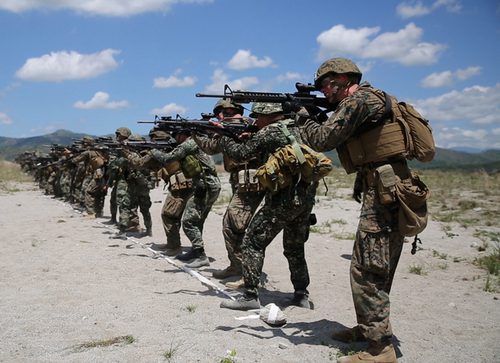
But as these discussions unfold, a U.S. Tomahawk cruise missile was launched from Tacloban during Balikatan 2026—the first live firing of its kind from Philippine soil since the deployment of the Typhon missile system. That launch says what the summit’s official language cannot: while ASEAN speaks of peace, Philippine territory is being prepared for war.
The Cebu summit and the missile launch in Tacloban must be read together. One projects the diplomatic language of stability. The other reveals the military reality taking shape beneath it.
Together with deployments in Batanes and the continued expansion of military access arrangements, the launch marks a deeper integration of the Philippines into U.S. regional war planning. This is not routine defense cooperation but the steady transformation of Philippine territory into a forward operating platform in a confrontation whose consequences our people will bear.
And this cannot be separated from what is happening within the country. The Negros 19 `massacre belongs to the same process. The killings of peasants and rural organizers reveal what militarization looks like when directed inward. The same state machinery being aligned with foreign military strategy is also being used to suppress communities resisting land dispossession, extractive projects, and economic restructuring.
External militarization and internal repression move together: one prepares the country for regional confrontation; the other disciplines resistance at home.
This is why Balikatan cannot be understood in isolation. It must be read alongside the economic agenda being advanced here in Cebu.
ASEAN leaders are discussing energy security, maritime stability, digital connectivity, and supply-chain resilience as technical challenges requiring regional coordination. But these are inseparable from the wars, sanctions, blockades, and military rivalries reshaping the region.
The ongoing war on Iran
ASEAN is discussing disruptions in energy flows through the Strait of Hormuz as though these were external shocks to be managed. But these disruptions are consequences of military escalation and coercive pressure imposed on states asserting political and economic autonomy.
The same contradiction appears in maritime security discussions.
Regional leaders speak of de-escalation in the South China Sea even as missile deployments, military exercises, and expanded strategic positioning continue to intensify. De-escalation is spoken in one register while escalation proceeds in another.
The contradiction is just as visible in the economic sphere.
Projects like the Luzon Economic Corridor are being promoted as pathways to modernization and resilience. But the Philippines is not being developed as an industrially sovereign economy.
It is being positioned as a source of cheap labor, low-value raw materials, and logistical support for strategic supply chains organized around foreign priorities. This is what has been described as Pax Silica—the fusion of technological production, logistics, and military strategy under a regional order shaped by strategic competition among major powers.
This restructuring extends into education
The reduction of General Education requirements in higher education is often defended in the language of efficiency and competitiveness. But when history, philosophy, literature, and critical social thought are pushed aside, what is being produced is not simply a technically trained workforce. It is labor stripped of the intellectual tools needed to understand the conditions shaping its own exploitation.
This is not merely a curricular issue. It is part of preparing the kind of workforce required by a semicolonial economy organized around foreign strategic demand.
So when we challenge this summit, we are not rejecting regional cooperation.
We are rejecting a model of regional integration that normalizes military escalation, deepens economic subordination, and treats sovereignty as negotiable.
We reject the conversion of Philippine territory into a launchpad for war. We reject the use of state violence against communities defending land and livelihood.
We reject an economic order that calls dependence “resilience” and militarization “security.”
And we affirm the need for genuine regional solidarity grounded not in strategic alignment with rival powers but in sovereignty, justice, and peace.
The question before us is simple: Will this region continue adjusting itself to the demands of militarization and foreign strategic competition?
Or will its peoples assert a different future—one grounded in self-determination rather than subordination? #