By: Alvinson V. Aligam
Typhoon Crising and the relentless habagat (Southwest monsoon) brought days of heavy rain and flooding to many parts of the Philippines. In these very familiar situations, we expect government agencies to professionally do their job: update the public, announce class or work suspensions, organize evacuation efforts, and coordinate relief distribution. These public announcements are lifelines, tools that help us prepare, act, and survive.
But what happens when those announcements are treated like opportunities to poke fun at what should be serious – life and death even – matters? When humor takes over in a crisis, the message loses urgency. It thus becomes insensitive.
As I scrolled through Facebook these past few days, I can’t help but feel confused. Are these announcements meant to inform, or are they trying to entertain? As agencies like the Department of the Interior and Local Government (DILG) post updates using Gen Z slang and trendy humor, calling those who depend on them such as local government units and rescue agencies “Mga Abangers,” I can’t help wonder at first if I stumbled into a “fake” account. But it is DILG’s official account, proudly bannered by the folksy tag “Sec. Jonvic,” referring to the head of the agency.
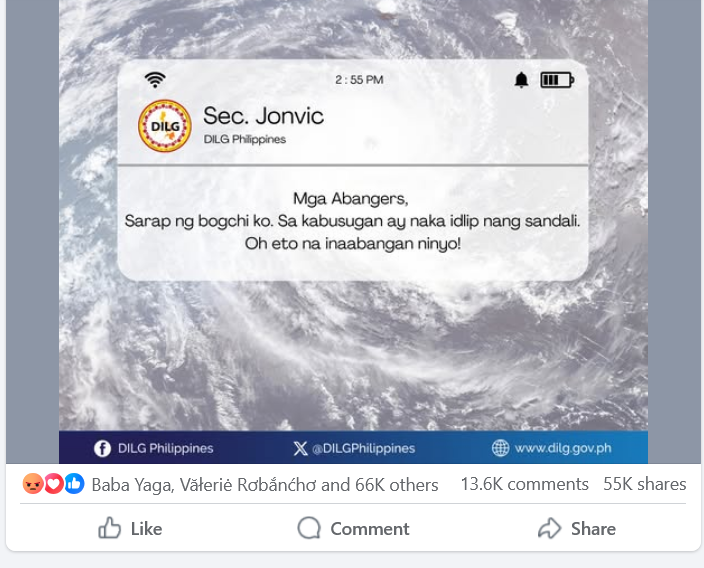
Sure, it is attention-grabbing. But does it convey the urgency of the situation? Or does it end up trivializing the suffering of many?
This might seem harmless to some. A little humor, after all, might make the serious and the grave a bit digestible. But for others, especially those directly affected, it feels deeply disrespectful. In fact, many netizens have already voiced their disappointment. The use of jokes, memes, and insensitive language feels like a cruel joke when you’re stranded on your rooftop, waiting for help to arrive.
As one concerned netizen commented:
“Many of our fellow citizens are facing difficulties due to the circumstances that prompted the suspension. Government announcements carry weight and influence, and they set the tone for how the public perceives and responds to critical information. We hope future communications can be delivered with the seriousness and empathy they deserve, especially when public welfare is at stake.”

This kind of feedback reflects not just frustration but a longing for sincerity, responsible governance, and communication that respects the gravity of people’s realities. Humor, in these contexts, is not harmless. It becomes a barrier to empathy and accountability.
[READ] INSENSITIVE JOKES HAS NO PLACE IN A CRISIS: BIEN SLAMS DILG’S TONE-DEAF POST
Foreigners wonder why Filipinos still laugh even in the worst of times and situation. Heck, we even find humor in how our politicians are described as one of the most corrupt public officials in the world. Over time, and despite all logic and reason, we have taken our sense of humor to mask our deepest of problems.
We also continue to romanticize, even glorify, resilience and volunteerism when we should not, being the victims. We have this lost the ability to demand accountability from the government. What’s more troubling is how government officials and agencies try to misuse humor in government announcements, framing disasters as something to laugh about rather than crises that require decisive and serious leadership.
“Sec. Jonvic’s” brand of humor and woeful sense of timing is therefore totally unexpected when lives are at stake. Other government agencies have in fact announced that 12 have died while tens of millions in crop losses have been estimated so far because of the rains and floods in recent days.
Clarity and compassion matter more than clicks and shares in times of disasters. The DILG must be aware and accountable for the information it releases. Public announcements are not meant to entertain; they are meant to save lives. Humor has its place but not when people are drowning, not when homes are destroyed, and not when lives are at risk. Humor would always have a place in every Filipino’s psyche, but not when actual help and succor is needed first to save lives.
When humor becomes the tone of public announcements, it reinforces the idea that surviving disasters is simply part of being Filipino, that it’s okay to smile, make memes, and move on because we can always laugh our troubles away. But this normalization, disguised as relatability, not only dulls the urgency of the situation, potentially putting more lives at risk. It conditions us to accept disasters not as failures of governance but as another moment of collective bonding, distracting us from the real question: Why do we keep suffering in the first place? #