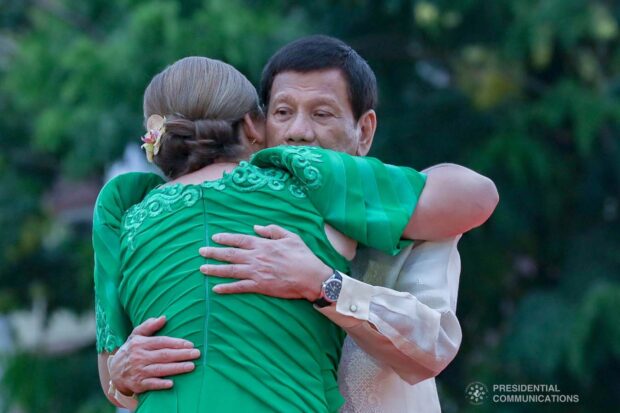
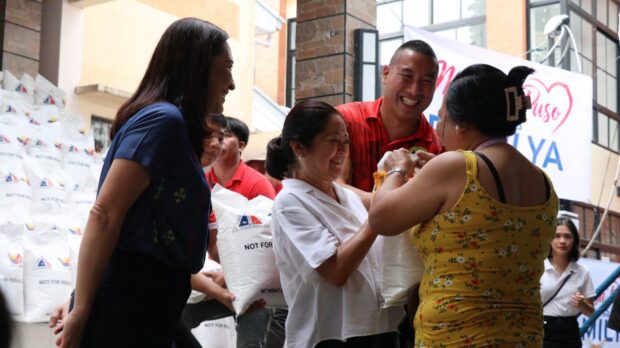
First lady Liza Marcos launched a week-long rice-giving drive to poor Filipinos in the country’s capital on Monday, dubbing the initiative as “immediate relief” to families in need. Government media said the First Lady’s program is part of the Ferdinand Marcos Jr. government’s food assistance project to poor families.
Initially targeting 210,000 families in Quezon City, the drive distributes 10 kilos to each recipient. The project, however, Quezon City Mayor Joy Belmonte revealed, is funded by local governments and not by the Marcos administration.
Belmonte emphasized that the rice is sourced directly from local farmer cooperatives to support domestic agriculture. “This is local rice, not imported rice, because we want to help our local farmers,” Belmonte said.
Metro Manila Council president and San Juan City Mayor Francis Zamora subsequent waves of distribution will be implemented in various other cities in the National Capital Region. Zamora added that the program shall eventually be cascaded in other parts of the Philippines.
The distribution reflects the Marcos Jr.’s administration to mitigate the impact of inflation on basic commodities brought about by the Middle East war, authorities said.
Is 10-kilo rice enough?
The Marcos government, however, is accused by local economists of not doing enough to help poor Filipinos when the United States and Israel started their war against Iran at the end of February.
Aside from selling rice at P20 in limited locations and cash assistance to public transportation workers, Marcos Jr. refused to suspend excise and value added taxes on petroleum projects, driving inflation rates to record highs. This strategy contrasts starkly with tax reliefs implemented by the Philippines’ neighboring countries, such as Vietnam and Indonesia.
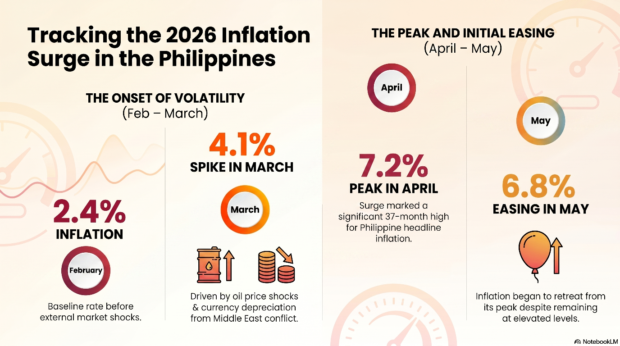
Inflation in the Philippines reached 6.8% in May, easing from a 37-month high of 7.2% in April, which had surged due to oil and supply shocks triggered by the Middle East conflict. The situation makes it harder for more Filipino families to afford rice, Asia’s staple.
Meanwhile, basic daily wage in the Philippines substantially varies from P376 in the Muslim region in Mindanao to P658 in the capital. A kilo of rice, enough for a family of five’s daily consumption, is regularly priced at P58 per kilo.
Rice farmers face ruin
Among the hardest hit by the effects of the Middle East conflict in the Philippines are rice farmers themselves. Just as they were about to begin their rice cropping season last March, inflationary effects of the West Asian war heavily impacted their production costs.
“Before the war, rice production cost per hectare was at P60,000. It has since risen to P95,000 on the average,” Unyon ng Manggagawa sa Agrikultura national president Ariel Casilao told Kodao.
Casilao said farmers were forced to buy fuel at nearly triple the price in March and April when their use of tractors and irrigation pumps were at their peak. Predatory pricing of fertilizers, herbicides and pesticides, driven by impending supply shortfalls with the constriction of the Strait of Hormuz, also affected production costs.
The former lawmaker said that farmers are hoping for a good yield despite reduced production inputs to offset the price shocks caused by the West Asian conflict.
He added that while the Marcos government is using rice – either cheaply priced or distributed to select families – it has neglected the rice producers who face financial losses from this year’s first cropping season. # (Raymund B. Villanueva)