By Bagong Alyansang Makabayan
Marcos Jr.’s Executive Order (EO) No. 110 shifts the burden of the global oil crisis, caused by US–Israel imperialist aggression against Iran, onto ordinary Filipinos, while leaving intact the very policy framework that produced the country’s vulnerability in the first place.
EO 110 places heavy emphasis on energy conservation directives and market-management tools that effectively ask the public to shoulder the burden of the crisis, while offering only piecemeal, conditional relief. It is a compilation of previously announced, insufficient band-aid measures dressed up as a comprehensive emergency response. Yet, it is completely silent on the immediate and urgent need to control runaway prices and bring down fuel costs for commuters, transport workers, farmers, fisher folk, and poor families.
It operates within the logic of the Oil Deregulation Law (ODL) and a deregulated, privatized energy industry, which the crisis has already exposed as deeply flawed in addressing the current oil shock. It is highly doubtful that the government can effectively address hoarding, profiteering, and supply manipulation within such a context. Market actors with concentrated power will exploit regulatory gaps unless the state asserts decisive control over prices, strategic reserves, and distribution.
There is no meaningful mechanism to suspend onerous oil excise taxes, including the 12% value-added tax (VAT), nor is there a credible and enforceable plan to bring down pump prices immediately. This omission leaves the poorest to bear the cost of the imperialist war being waged by the US and Israel.
We are also concerned that the declared emergency may be used to fast-track big-ticket corporate investments, including large renewable energy (RE) projects and other infrastructure, without genuine consultation with and consent from affected communities, or adequate environmental safeguards. Under the cover of urgency, the government may accelerate permits, approvals, and financing that benefit corporations while displacing communities, degrading ecosystems, and locking the country into private, profit-driven energy mega-projects that do not guarantee affordable power for the people and energy security for the country.
Let us not forget how ill-conceived previous declarations of national emergency have caused more and bigger problems for the people than the crisis such declarations are supposed to address. During the COVID-19 pandemic, for instance, former President Duterte had significant powers under the Bayanihan to Heal as One Act. It became a brutal, militarized response to a public health crisis, marred by a chronically under-prepared and ineffective public health strategy and economic policy that inflicted severe hardship on the most vulnerable sectors, on top of massive corruption. Former President Ramos also enjoyed emergency powers to address the national power crisis in the 1990s, which the government used to enter into onerous contracts with independent power producers (IPPs). These IPP deals contained take-or-pay provisions that forced consumers to pay for electricity they never used, as well as sovereign debt and fuel cost guarantees that massively inflated the country’s public debt.
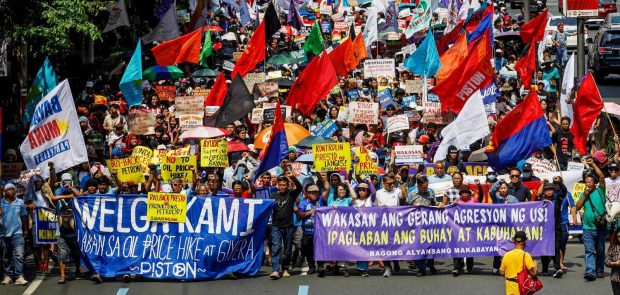
To truly address the crisis, we reiterate our six-point demand:
- Oppose the US–Israel war and call for the immediate cessation of military operations against Iran. The government should initiate efforts to promote global and regional peace and stability and to de-escalate the war that is causing the oil shock. This includes the withdrawal of US troops and weapons stationed in the country under the Enhanced Defense Cooperation Agreement (EDCA), as well as other US military agreements that are stoking tensions in the region.
- Defend the livelihoods of working people by raising the minimum wage in both the public and private sectors to a decent living wage, increasing minimum fares for public transport workers, and providing sufficient production support to farmers and fishers.
- Control the prices of fuel and other basic goods and services, and curb profiteering and other abuses by big corporations, including oil companies.
- Roll back pump prices immediately by removing VAT and excise taxes on petroleum products and imposing a cap on oil companies’ profits.
- Provide immediate, guaranteed, unconditional, and sufficient cash assistance and fuel subsidies for public transport drivers, farmers, fisher folk, poor households, and other vulnerable sectors.
- Scrap the Oil Deregulation Law and end neo-liberal energy policies. The government must reverse privatization and deregulation policies that enable corporate profiteering and other abuses and restore state regulatory powers to control prices and ensure supply security. #