Violeta was among the early shoppers of a community market in Quezon City on Wednesday morning, carrying with her P1,000 as the day’s budget for meals. Instead of her usual kilo of bangus – her family’s favorite – she chose two medium-sized pieces and asked the fishmonger to slice them into eight pieces.
“We are exactly eight in the family. This way, everybody would have their slice. Gone are the days when some of us could have extra,” she explained. A kilo of milkfish currently costs P300 from P260 last March.
Violeta next bought kangkong greens as additional ingredients for the sinigang she was planning to prepare for lunch, but she did away with the usual radish. She next bought half a kilo of chicken, asking for meaty portions, for tinola for dinner.
“I have been cooking lots of soup-based meals lately,” Violeta said. “They could feed my family more than other meals,” she added.
Pandemic-like crisis
The Middle East war-induced inflation in the Philippines is forcing families to be creative in spending their shrinking purchasing power as the crisis pushed food prices to Covid-19 pandemic levels. From a modest 2% in January, it shot up to 7.2% in April, surprising even economists who earlier predicted a 6.3% jump last month.
Philippine Statistics Authority civil registrar general Claire Dennis Mapa revealed the peso’s purchasing power has slid to P0.732, its lowest since 2018, further straining a regular Filipino family’s daily budget.
The peso also registered its lowest value compared to other currencies, trading upwards of P61.50 compared to the US dollar.
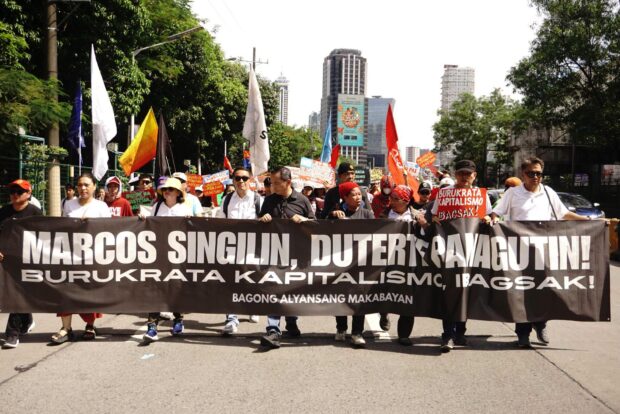
IBON Foundation said the inflation burden is heavier on millions of Filipinos amid lack of action by the Ferdinand Marcos Jr. government. IBON said the country’s inflation could have been managed better had the government urgently moderated price increases, especially on fuel and food, as soon as the hostilities started.
“First, inflation could have been significantly tempered if the government had cut oil taxes, regulated overpricing by oil firms, and implemented a stricter and non-voluntary price freeze,” IBON said. “The situation fully warrants these emergency interventions and would have prevented rising fuel costs from fully cascading across the economy,” it added.
The Marcos Jr. government refused to intervene in fuel prices as the Middle East war rages, choosing instead to provide one-time cash aids to transportation workers.
‘My basket is light’
Violeta, whose three employed children work in call centers, is not eligible for such cash aids.
After buying additional aromatics for cooking, she proceeded to the market’s rice section, choosing the medium-priced variety of P55 for a kilo.
“That’s all that my P1,000 could buy. It’s time to go home,” she said.
But instead of taking a tricycle as she used to do, Violeta chose to walk all the way back home.
“I can manage,” Violeta said. “My basket is light.” # (Raymund B. Villanueva)