An international media group strongly condemned what it calls the smear campaign carried out by the Chinese Embassy in the Philippines against the Philippine Center for Investigative Journalism (PCIJ).
Reporters Without Borders (RSF) said the embassy’s attacks have triggered a wave of online harassment against the independent media outfit, aimed at discrediting serious journalism examining Beijing’s influence operations in the country.
“These attacks quickly triggered a wave of online harassment. Within two hours of the embassy’s first Facebook post, more than a hundred accounts had commented on or shared the post, repeating the embassy’s narrative that PCIJ’s coverage was ‘anti-China,’” RSF said.
The PCIJ— an award-winning independent investigative organisation — has been the target of attacks by the Chinese Embassy in Manila since 25 February 2026, starting when a government official shared on social media an article by PCIJ contributor Regine Cabato about Chinese disinformation operations in the Philippines.
In several Facebook posts, embassy spokesperson Guo Wei accused the outlet of promoting “anti-China rhetoric” and described its reporting as “deliberate smears.”
One of these posts included a screenshot of a post by a senior Philippine coast guard — who is regularly targeted by the Chinese embassy – sharing Regine Cabato’s video report and thanking her for exposing pro-China propaganda. The screenshot displayed the journalist’s name and face.
Cabato also received abusive messages in her private inbox.
“These accusations were further amplified by the Philippine Chinese-language newspaper World News, whose editorial line is known for being aligned with the positions of the Chinese government.
In a statement released on 13 March, the Presidential Task Force on Media Security (PTFOMS), said it was “alarmed by reports of a systematic disinformation campaign allegedly orchestrated by foreign entities against Cabato and the PCIJ.”
“By targeting an independent journalist and an award-winning investigative organisation, the Chinese regime is demonstrating its determination to silence reporting that exposes Beijing’s disinformation efforts in the Philippines. We call on the Philippine authorities to oppose the embassy’s attack on independent media and, more broadly, take action to protect journalists investigating foreign influence and information manipulation operations in the country.” — Aleksandra Bielakowska, Advocacy Manager, RSF Asia-Pacific
Many of the accounts that relayed the embassy’s attacks against Regine Cabato and the PCIJ openly support former Philippine President Rodrigo Duterte.
Due to Duterte’s close ties with Beijing, his supporters are key conduits for Chinese influence operations in the Philippines. Last year, several pro-Duterte influencers and journalists admitted to participating in fully funded training programmes in China designed to help them increase their social media following and promote narratives favourable to the Chinese regime.
“Since my report was posted, I’ve been on the receiving end of a barrage of online harassment. These include sexist remarks, taunts to engage in debate, and baseless accusations that I am some kind of CIA plant. To watch these accusations from the Embassy getting amplified in real time by pro-Duterte partisans was alarming and only seems to prove that these parties have shared interests. Hopefully, Philippine officials will be able to convey that freedom of the press, speech, and academia is taken seriously here.” — Regine Cabato, Independent journalist and PCIJ contributor
Influence operations in the media environment
The embassy’s attacks are part of a broader pattern of Chinese influence operations in the Philippines’ information space, the RSF said.
In late 2025, an investigation by Reuters revealed a coordinated opinion-manipulation operation linked to the Chinese embassy in Manila. According to the investigation, the diplomatic mission allegedly funded a Philippine company to create a network of fake Facebook accounts tasked with spreading pro-Beijing and anti-US content.
The operation also aimed to boost the visibility of a website created to promote CCP-friendly narratives under the guise of journalism, the international media group said.
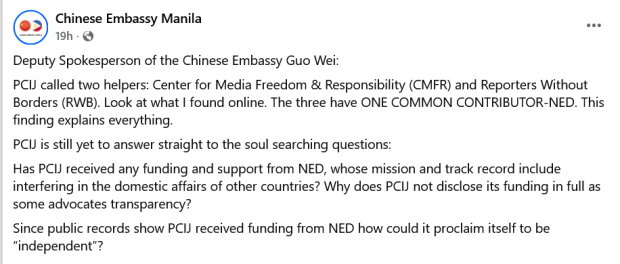
In another post on Thursday, Chinese Embassy deputy spokesperson Guo Wei accused local media watchdog Center for Media Freedom and Responsibility (CMFR) and the RSF of having received funding from the National Endowment Fund (NED) of the US themselves.
The post on the embassy’s Facebook page accused both the CMFR and the RSF, as well as the PCIJ, of being tools for NED’s “interfering in the domestic affairs of other countries.”
“Why does PCIJ not disclose its funding in full as some advocates transparency?” it added.
The PCIJ has yet to directly respond to the Chinese embassy’s accusations.
In a reaction, National Union of Journalists of the Philippines national chairpersonJonathan de Santos, however, said there is a difference between “funded” and “bought and paid for.”
“Project support doesn’t mean getting to make executive or editorial decisions. I don’t think our friends at the CMFR at RSF can be dictated upon,” de Santos said.
The Philippines ranks 116th out of 180 countries and territories in the 2025 RSF World Press Freedom Index; China ranks near the very bottom, in 178th place, and is the world’s largest prison for journalists, with at least 121 currently behind bars. # (Raymund B. Villanueva)