By L. S. Mendizabal

4.5 OUT OF 5 STARS
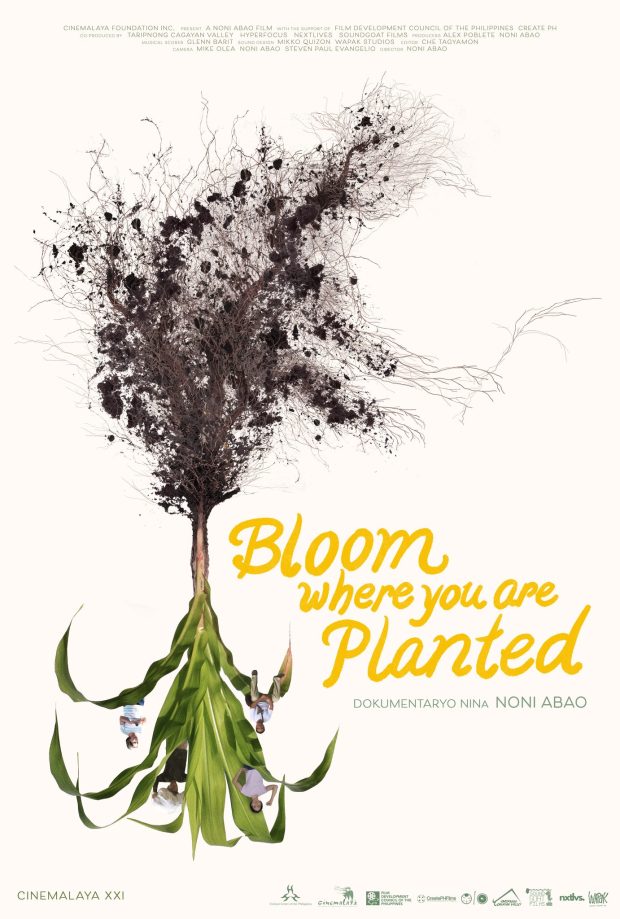 The political intent of the first documentary to win Best Film at the Cinemalaya Philippine Independent Film Festival, Bloom Where You Are Planted, could not have been more explicit. Produced, written and directed by Noni Abao, the film bears a message that is as plain as harvest day in Cagayan Valley under the blistering heat of a summer sun. Encroaching sneakily from the blistering heat, however, is a comforting warmth akin to that of a mother’s embrace or a childhood friend’s arm around one’s shoulder.
Bloom opens with scenes of protest in the streets of Manila. Chants amid the city’s cacophony fade into a soft acoustic rendition of The General Strike’s Kawayanan as the audience is taken north, moving past cityscapes to the countryside. A woman’s voice begins to describe the idyllic beauty, vastness and richness of Cagayan Valley. The narration is accompanied by breathtaking establishing shots of landscapes encompassed by a soft blue sky, close-ups of vivid yellow grains bowing to their reaper, man or machine, and wide shots of lush green fields from afar, bespeckled with cows, carabaos, farm workers, threshers and trucks. Enclosing these painting-like spectacles (I swear I saw a brief shot of paddy fields and mountains elegantly framed by trees and foliage that could only have been Parts Bagani-inspired) are the Cordillera and Sierra Madre mountain ranges.
A Mother Under Attack
We soon find out that the voice belongs to Agnes Mesina, a community development worker who has since the 90s dedicated her life to advocating for peasant rights, indigenous peoples’ rights and environmental protection in the region. Agnes radiates wonder, vigor and passionate courage rarely seen in a charismatic combination in people her age or experience. She, her fellow workers and local farmers have organized an ongoing movement opposing large-scale mining operations, land-grabbing and militarization in the valley. Threatened by the people’s resistance, the state has red-tagged Agnes and her peers to sow fear among the locals.
We then get acquainted with Gab, Agnes’s son, a graduating college student in the University of the Philippines–Los Baños (UPLB). Through the years, Gab has gotten used to long intervals between short meetings with his mother due to the perilous nature of her work. Smiling his mother’s smile, he tells the audience that he thoroughly understands Agnes’s activism, and that he was raised to be emotionally primed for her arrest should that day come — and that when it did, it definitely “ruined his night,” but that “he had to be strong.”
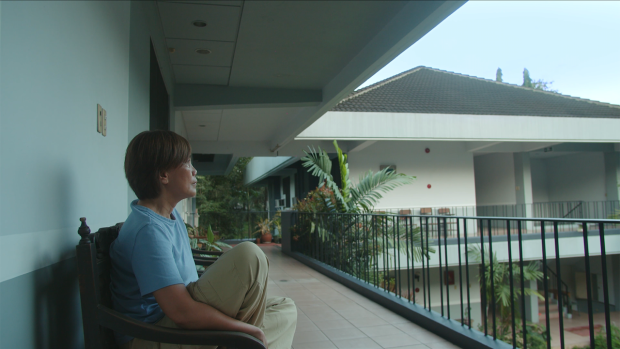
A welcoming voice-over narration, deeply intimate character studies, and frightfully casual ways of disclosing said characters’ vulnerability to life-threatening danger — this is how Bloom guides us into its triptych of stories. Divided into three chapters, the documentary masterfully weaves the stories of three people from different generations and backgrounds, forming an exquisite, cohesive tapestry of candid interviews, photographs, family memorabilia, archival footage, news reports, and animation.
A Mother Behind Bars
Naturally, I was not prepared for the second subject (though I recognized a closeup of her big brown eyes in the teaser): Amanda Echanis, a cultural worker, writer and researcher, whose work had brought her to Cagayan Valley to conduct a study on the expansion of yellow corn plantations causing soil degradation and contributing to climate change.
When Amanda was arrested in Baggao, Cagayan in December 2020 for charges fabricated by the state — i.e., being a member of the New People’s Army (NPA), illegal possession of firearms and explosives — heavily armed military and police personnel found clutched to her breast not an assault rifle, but a month-old infant. Amanda’s son, Randall Emmanuel, was named after his grandfather, Randall Echanis, a National Democratic Front of the Philippines (NDFP) peace consultant. The elderly Randall was 72 and terribly ill when he was tortured, stabbed 40 times, and killed in his Quezon City home a few months before Amanda’s arrest. As of this writing, Amanda raises her son, who’s since been in her mother Erlinda’s custody, from a jail cell through a phone’s pixelated screen.
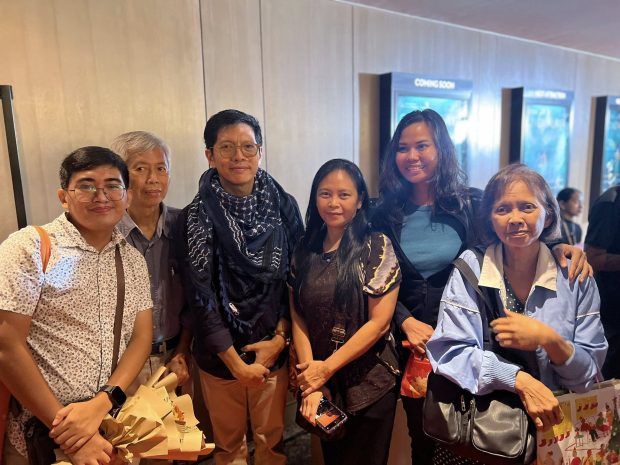
In spite of the tragedy that has befallen their family, Amanda’s distinctive big brown eyes and wide, toothy smile have not dimmed; it is the same exact amiable face I was introduced to by a common friend at the newly constructed College of Arts and Letters building in UP Diliman. She invited me to join a student writers’ organization; I declined politely (I was already a member of a film organization). Now, Amanda and I are both mothers of children around the same age. I feel for her as I reflect on the fact that little Randall is now as old as her time in detention, and that Nanay Erlinda, despite looking cheerful in her interviews in Bloom, visibly ages before the audience’s very eyes as a scene of her wailing over the elderly Randall’s casket is followed by a scene of her tiny, frail body scooping up little Randall who runs to her arms in excitement after receiving an award at his Kindergarten graduation ceremony.
A Childhood Friend Murdered
Ushering the audience into the documentary’s third chapter is Kodao Productions’ very own Raymund Villanueva. Under the Marcoses’ pendulous shadow in the north, he grew up in Isabela with slain NDFP peace consultant Randy Malayao.
Randy was 49 when he was murdered in January 2019. He was homebound, sleeping in a Victory Liner bus, when he was shot at close range by an unidentified gunman. Before the assassination, Randy had participated in the formal peace negotiations between the NDFP and the Philippine government in Europe. As part of former president Rodrigo Duterte’s crackdown on activists, he and his peers were tagged as “terrorists” by the Department of Justice (DOJ) in 2018.
It was not Randy’s first rodeo at being targeted by state terrorism. His entire adult life, which he’d dedicated to peasant and human rights in Cagayan Valley, was riddled with red-tagging, military abduction, torture and illegal detention. Randy’s leadership and fighting spirit were indefatigable. Even in prison, he continued working as an organizer and activist, facilitating reforms for the prisoners. Eventually, he’d be elected prison governor in Tuguegarao and Ilagan jails.

Raymund shares a story about how a cellmate got jealous of the attention Randy was getting, and tried to stab him. The other prisoners were quick to respond, shielding him and attacking the assailant, but Randy stopped them. He approached the man and asked him why he’d want to hurt him. The man replied that it was not fair for Randy to have two electric fans. “Iyon lang pala, sa’yo na ‘tong isa (“Is that it? You can have the spare”),” said Randy.
On his childhood friend’s first death anniversary, Raymund went home to Isabela and was shocked to find that he was aboard the same Victory Liner bus Randy was brutally killed in. He noticed how one of the windows was newly installed and freshly tinted—an unnerving contrast to the older, dustier windows that lined the bus.
“Up to now, I still find myself crying, grieving for my friend,” Raymund says to the camera, his eyes, welling with tears, slightly evading our gaze.
Sharp like a Bolo Knife
There is something dreadfully heartbreaking about watching Agnes’s, Amanda’s, and Randy’s loved ones recount their cherished moments with the subjects. And yet, the documentary does not end there. Neither does it begin there. Not only are we invited to these people’s sacred relationships and inner lives; we are taken to the place and thread that ties them together yet apart: Cagayan Valley and the peasant struggle nestled within.
From film poster to teaser, from opening scene to end credits, Bloom does not shrink from its clearly defined ideological position—the calls are literally shown scribbled on placards and makeshift streamers: “Free all political prisoners!” “Defend life, land, water and resources!” The documentary’s main message is undeniably sharp and courageous. In its epilogue, Bloom takes us back to the city through a frenzied montage of the Filipinos’ everyday struggle — e.g., the daily commute, widespread flooding, street protests — to Ruby Ibarra’s Bakunawa. Having acclimatized to the stillness of what preceded it, I must admit, I found the epilogue jarring at first. It did not feel like I was watching the same film, it almost felt like an afterthought.

But as the credits rolled, it became clear to me that as much as Agnes, Amanda and Randy are the subjects of the documentary, it is not really about them, or their loved ones’ longing or grieving. Bloom is about the people’s struggle, the power it yields and the price it asks of those who dare try to change a system that’d rather profit from a mining company’s obliteration of a whole mountain than give land to the farmers who till it to feed an entire nation. In the teeth of its perils, activism is not only persistent; it is logical, just and necessary.
“Hindi maling lumaban. May mali kaya lumalaban (“It is not wrong to fight. We fight because there is something wrong”),” says Amanda in one of the voice-over narrations.
Patient like a Farmer
Informed by his personal experience as a human rights worker and community organizer in the region, Abao’s deft writing delivers political and emotional impact that’s elevated further by Steven Evangelio and Mike Olea’s vivid cinematography. Che Tagyamon, who deservedly won Best Editing at Cinemalaya, integrate all three stories so succinctly and poignantly that the audience is not left wondering or wanting.
It bears mentioning, however, that Bloom is not for the impatient, not because of its length (with a runtime of 82 minutes), but because of its pace. The documentary, which took six years to make from conception to production, certainly takes its time. It patiently listens to its subjects, including their sighs and pauses, distant stares and averted glances. There are not many cuts or tricky transitions. The score barely heightens to a crescendo, except in the epilogue. Bloom allows us to take in everything — the sluggishness and laboriousness of life in the countryside, the serene beauty and slow tragedy of the valley.
The documentary’s greatest strength lies in its quietest, most contemplative moments — resting farm workers camouflaged among corn stalks, a self-conscious Agnes making silly faces at the camera, Amanda’s voice cracking while reading a poem she wrote about her parent’s love for each other, Nanay Erlinda smoking in between interviews, Raymund sitting silently by Randy’s grave. We can tell that every single shot was made by the filmmakers with love and utmost care, respect and empathy.
Rise of the Political Documentary
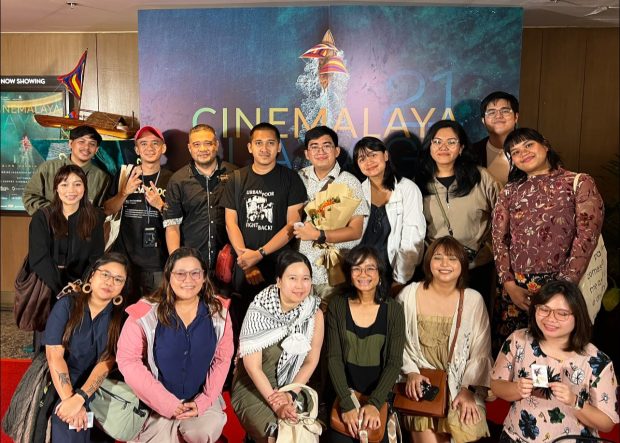
Bloom’s recent Cinemalaya wins, back to back with the Gawad Urian Best Picture, Best Documentary and Best Editing awards received by JL Burgos’s Alipato at Muog, along with the accolades given to Maricon Montajes’s River of Tears and Rage (incidentally, written by Raymund Villanueva) are but recent manifestations of flourishing young talent in Philippine cinema, particularly in the political documentary genre. This emergence of progressive political films that go above and beyond your run-of-the-mill melodrama, I hope, extends to fictional cinema.
These documentaries’ approaches to tackling the themes of human rights, state repression and fascism may differ, but they do have one thing in common: the more personal, human perspectives and private worlds of the marginalized. Far from merely looking inward, these films have managed to humanize the faces printed on the flyers given out by police and military, aired on TV before the news anchor moves on to feel-good content, and drawn on placards carried by protesters calling for justice. Activists are people, too, with children, parents, spouses and friends who love and care for them. They take the road less traveled because they cannot see themselves on any other road. In Agnes’s words, “When you decide how to live, you decide how you die.”
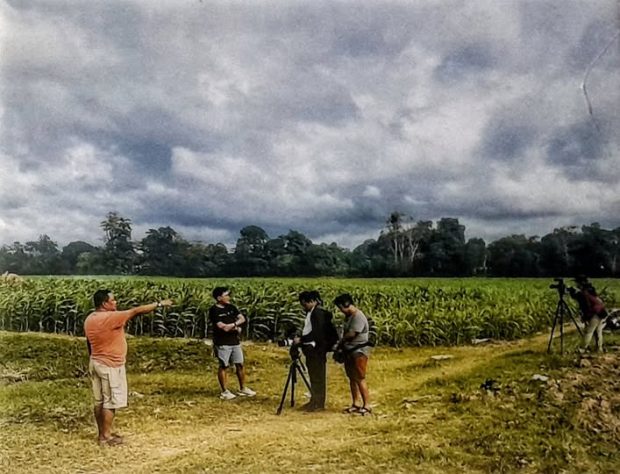
At once sharp and tender, Bloom provides us an almost comprehensive view — I say almost, because I do wish that there was a fourth subject from the peasant sector — of the splendor and struggle, loves and losses, and life and death all cradled together by the valley which all three subjects of the film, at varying points in their lives, called home and taken root in.
Bloom was a painstaking labor of love. Six years in the making, the documentary has itself patiently taken root in the same valley, and has grown and bloomed where it was planted. It is only a matter of time before the next harvest of more seedlings, of more films that tell stories of hope, resilience and the continuous fight for freedom. #