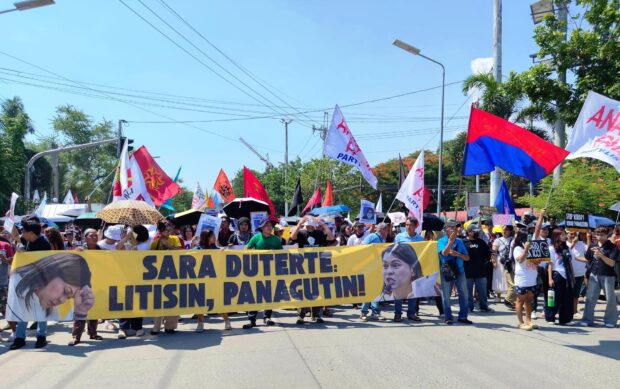
Major cities in the Philippines woke up to noticeably less noise on Thursday as public transport drivers launched their nationwide transport strike amid runaway fuel prices brought by the war in West Asia.
The usual, almost permanent, cacophony of horns and blaring exhaust pipes are replaced by angry voices demanding government control of runaway fuel prices.
Enraged by President Ferdinand Marcos Jr.’s veto of announced fare hikes yesterday, thousands of public transport workers took to the streets to condemn government’s refusal to suspend taxes on petroleum products.
In Manila’s metropolis, transport group Piston, supported by various activist groups, put up at least 17 strike centers with several major thoroughfares reporting of 85% paralysis.
In Cebu City in central Philippines, transport paralysis is between 75 to 100% as of 10 AM Thursday morning.
Piston president Mody Floranda reported 75% paralysis in Metro Manila.
‘Starving workers, making oil companies fatter’
Piston fumed at the decision to prohibit the increase in fares, accusing Marcos of starving drivers while oil companies even fatter.
Marcos on Wednesday unexpectedly banned a permanent base fare increase to P14 (from P13) for the first four kilometres of the commute, plus P2.00 for every succeeding kilometer.
Varying fare increases were also approved by the Land Transportation Franchising and Regulatory Board for modern jeepneys as well as city and provincial buses.
“The miniscule fare increase of P1.00 was already an insult, yet Marcos vetoed it. All the while, he refuses to suspend excise and vale added taxes on petrol, diesel and gasoline that allow companies to profit more from the global oil supply crisis,” Floranda said.
Floranda revealed that leading oil company Petron alone reported a profit of P15 billion in 2025 while his fellow drivers no longer earn as diesel prices have more than doubled since the war begun last February 28.
Jeepney drivers used to earn an average of P500 after 12 to 14 hours of plying their routes before the war in west Asia and when diesel was P55/liter. But with diesel currently at P96 to P120 per liter, many drivers are temporarily stopped plying their routes.
“There’s no more reason for us to go out driving. We would just be working for the oil companies while we no longer earn anything,” van driver Jeffrey Castro said.
Castro said he is thinking of shifting to parcel delivery service using a motorcycle. “Anything is better than driving a commuting vehicle while diesel prices are as they are,” he added.
Marcos inaction to backfire
Prior to the transport strike, the Metro Manila Development Authority (MMDA), the government’s traffic agency, has already admitted to a reduced motor traffic in the country’s sprawling capital.
“We are seeing a reduction in volume,” MMDA general manager Nicolas Torre III told reporters on Wednesday said. Torre added that, based on casual observation, traffic conditions have eased in some areas of the metropolis.
The MMDA as well as various government motor pools have deployed buses and trucks to assist passengers during the transport strike.
The Department of Transportation has also ordered Manila train lines to reduce fares by 50% during the duration of the transport strike.
Meanwhile, the country’s youngest legislator called on Marcos to take back his fare hike veto to ensure adequate public transport for students and young workers.
“”This (Marcos’ veto) will backfire. If the President really wishes that drivers could no longer earn from their trade, there will no longer be buses on the streets soon enough,” stated House Assistant Minority Leader and Kabataan Representative Atty. Renee Co. # (Raymund B. Villanueva)