It took a visit by Imelda Marcos to the Libyan president in 1976 to have several mosques built in Luzon after four centuries of absence
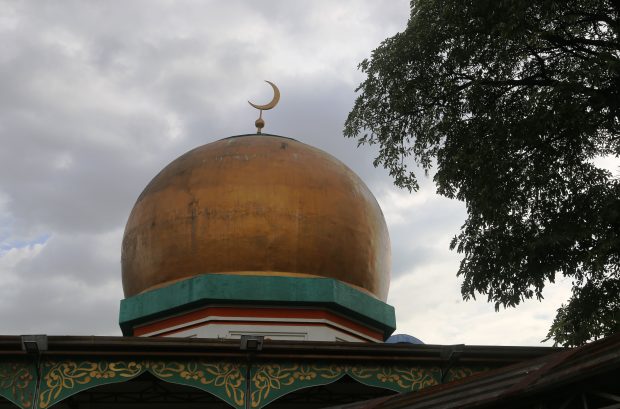
Manila’s Golden Mosque, the largest mosque in the Philippines outside of Mindanao, is the center of celebrations and prayers as Ramadan starts today in the Philippines.
An iconic structure in Manila’s downtown district of Quiapo, most Filipinos may think the mosque is older than its actual age. It is in fact just 50 years old this year.
There were no mosques of significant size or importance in what was once a Muslim ruled kingdom after Manila was turned into a Catholic city by the invading Spaniards in the 16th century.
Quiapo Islamic center historian Hadji Ali Alawi said Manila’s mosque was probably located in what is now the site of the Manila’s Roman Catholic Cathedral, near Rajah Sulayman’s palisade before the invaders again came in 1570.
“There is within the Cathedral an inscription from the Quran that may be an acknowledgement of what the site was originally about,” Alawi said.
For more than four centuries, Manila and the rest of Luzon island, once dominated by Muslim rulers from Pampanga to Batangas provinces, was bereft of a masjid, an Islamic place of worship.
Four mosques
It took a visit by former first lady Imelda Marcos to Tripoli in Libya in November 1976 for mosques to be built in earnest. Imelda was sent by her husband Ferdinand Sr. to then Libyan president Muammar Gaddafi to seek his assistance in the Philippine government’s civil war with the Islamic Moro National Liberation Front (MNLF).
Imelda’s visits to Libya were successful as the Tripoli Agreement granting limited autonomy for Muslim Mindanao was granted. She reportedly invited Gaddafi to visit the Philippines, to which the Head of State asked, “Will there be a mosque where I could pray?”
Known to be a builder of significant structures, Imelda reportedly ordered the building of four mosques in earnest, in time for the anticipated Gaddafi visit.
These were the Golden Mosque in Quiapo district, the Blue Mosque in Taguig City where a thriving Muslim community exists, one in Malacanang Palace, and one in the Marcos’ hometown of Paoay in Ilocos Norte province.
“Only the Golden and Blue mosques exist today. The one in Malacanang was converted to a library when President Corazon Aquino replaced Marcos,” Alawi said.
The mosque in Paoay was built should Gaddafi agree to visit Marcos’ hometown. Alawi said he does not know if it still exists.
Gaddafi did not push through with his visit to the Philippines however.
40 days construction
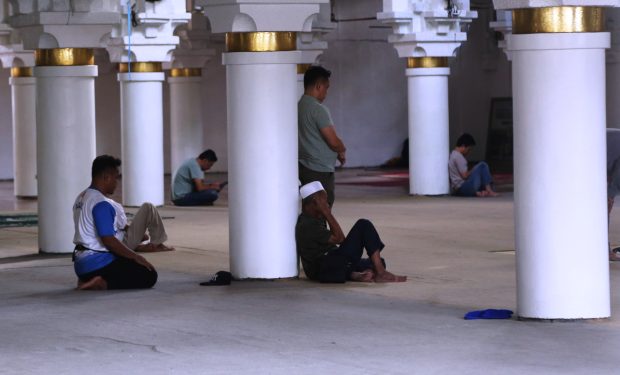
Muslims in Quiapo say it only took 40 days to finish the Golden Mosque.
“Muslim residents were conscripted to help in the swift construction of the Golden Mosque,” Alawi said. “Some of them are still living here in Quiapo,” the community historian added.
Unlike the blue-domed mosque in Taguig south of Manila, Quiapo’s masjid has a gold-colored dome as a nod to the shiny brass cannons that were used to defend Manila against the Spaniards. These were famously forged in famous foundry of the Muslim Panday (Blacksmith) Pira located on the north bank of the Pasig River.
The Golden Mosque is about 2,000 square meters in size and sits on a 3,000 square meters of land. Within it is Alawi’s Arabic School while a school to teach young Muslims the Quran sits on the compound northern edge.
A teeming community surrounds the masjid, making Quiapo an ever-vibrant community in the heart of Manila. # (Raymund B. Villanueva)