by Katrina Lazarra
For many Filipinos, balancing work and school is not a phase but a way of life. With the current state of the economy, young people are often left with no choice but to earn a living while pursuing their education.
Over the years, the Business Process Outsourcing (BPO) industry has become a popular employment path, thanks to the country’s strong English-speaking population and time zone advantage. With 1.57 million Filipinos employed in more than 1000 BPO companies in 2023, and has been growing 8-10% yearly since then.
For today’s youth, especially those striving for financial independence, it’s one of the most accessible yet demanding routes.
According to BPO Industry Employees Network (BIEN) president Mylene Cabalona, the BPO sector contributes US$35 billion to the economy, making it one of the country’s biggest gross domestic product contributor.
Melyn Rose Huyatid, a 20-year-old second-year college student, is a working student and part of Filipinos aged 18 to 34 employed in the BPO industry—an industry dominated by college students and recent graduates, 64% belonging to Gen Z.
Melyn is taking up a Bachelor of Science in Office Administration and joined the BPO workforce just seven months ago. Just recently regularized, she took the job not just to fund her education but also to help support her family.
Coming from a broken family and being the eldest child, Melyn feels a heavy responsibility to help her mother provide for the family. It’s a burden that often comes at the cost of her own well-being, with school and health sometimes being at risk.
Stepping Stone
While many college students enter the BPO industry, most don’t see it as a long-term career. For them, it’s a way to earn money while studying, rather than a path they plan to pursue after graduation.
Melyn sees her job in the industry as a path toward achieving her dreams, such as making sure her siblings don’t have to go through the hardships she experiences. A lot of student-workers like her enter the industry not out of interest but necessity. Often, the job has little to do with their college courses, their main goal is simply to stay afloat financially.
For third-year student Rei Kryztyn Mosqueda, joining the BPO workforce was a strategic move to gain financial independence and help her family. But she’s clear about where her heart lies.
“Once na matapos na yun, I’ll start to pursue my own career as well, which is in the field of law, hopefully,” she shared. (Once that’s done, I’ll start pursuing my own career—hopefully in the field of law.)
Journalism student Jaycel Dela Cruz shares the same sentiment. She’s already had an honest conversation with her team leader about eventually stepping away from the job once school becomes too demanding. “Kasi, para lang naman tustusan yung pag-aaral ko kung bakit ako nagpatrabaho,” she said, reiterating that she won’t think twice about letting go of the job when the time comes. (The only reason I started working was to support my studies.)
Justine Ruth Sumando, who has spent the last three years working in the BPO industry, is eager to finally pursue a career aligned with her course, Advertising and Public Relations. “I don’t think so na after graduation, i-pu-pursue ko siya (BPO),” she said. “Kasi as much as possible gusto ko i-practice yung course na natapos ko kasi gustong gusto ko talaga yung course ko.” (I don’t think I’ll continue in BPO after graduation. As much as possible, I want to practice what I studied because I really love my course.)
Setbacks
Being a working student might seem ideal. Earning money while pursuing a degree sounds like a smart move. But for students like Melyn, Rei, Jaycel and Justine, the experience is far from being glamorous.
Health, for one, becomes a fragile balancing act. When their body starts giving in, their job performance often suffers as well. Expected to show up for both class and work, working students find themselves constantly sleep-deprived. Over time, the lack of rest chips away at their immune system which leads to frequent illness and exhaustion that only adds to the struggle.
A study in 2025 showed that BPO workers in the Philippines are exposed to physical and mental stress, sleep disruptions, and work-related health issues due to the demanding nature of their jobs.
Melyn admits it’s a struggle, but she does her best to manage everything as much as she can. “Sobrang hirap sa part ngayon na pinagsasabay yung OJT, classes and work,” she said “Halos wala rin pong tulog. So, madalas po, nagkakasakit ganyan.” (It is really hard now that we have to do on the job training, classes and work. We hardly get sleep. I often get sick.)
Managing a full-time job alongside school often forces students to choose one over the other. For Jaycel, the decision is clear — school comes first. She emphasized that as a working student, making sacrifices are inevitable and is part of the process. “Di ka talaga pwedeng mamangka sa dalawang ilog,” she stated. (One can’t really row a boat on two rivers.)
But not everyone has the luxury to prioritize school. As the breadwinner of her family, Rei can’t afford to let her performance at work slip. She pushes herself to meet expectations to earn the incentives that come with it.
To keep up with school, she squeezes in reading and academic tasks during any free time at work. “You have to exercise and to exhaust all the available time and energy that you have as much as possible when you’re a working student,” she stated.
Despite the personal struggles many BPO workers face, BIEN’s Cabalona highlighted even deeper issues within the industry, most notably, the insufficient wages for these so-called “bayaning puyat,” (sleepless heroes) who earn just ₱12,000 to ₱16,000 a month in entry-level positions in Metro Manila.
There have also been continuous calls for better working conditions within companies, such as ensuring basic entitlements like 15-minute breaks are not compromised.
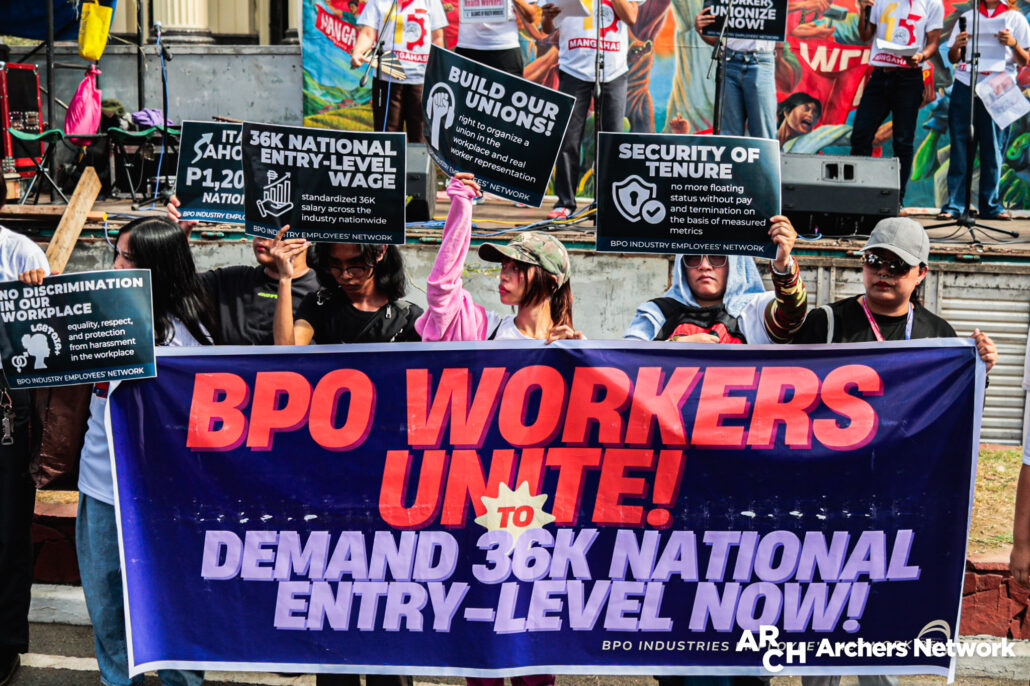
Even with the tireless calls to raise salaries, employees find it difficult to voice their demands directly to companies. This is because many BPO firms operate under the Philippine Economic Zone Authority (PEZA), which discourages them from forming labor unions. “Dahil sa kawalan ng union, kawalan ng labor organization, napakahirap mag-push ng wage increase, salary increase,” Cabalona explained.
Despite these challenges, labor groups and BIEN continue to push for a standardized entry-level wage of ₱36,000 nationwide. With the hopes of also easing the burden on working students like Melyn, Rei, Jaycel and Justine who strive not just to survive each shift but to eventually build careers that align with their passions. #