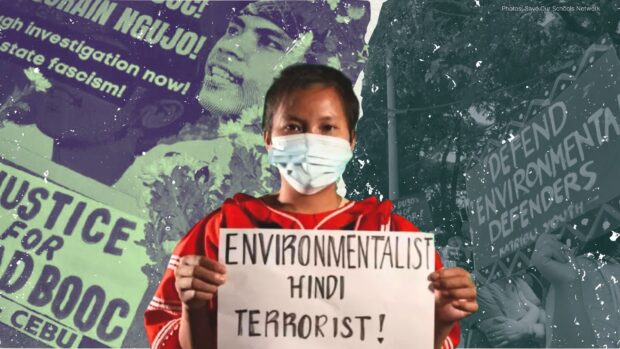
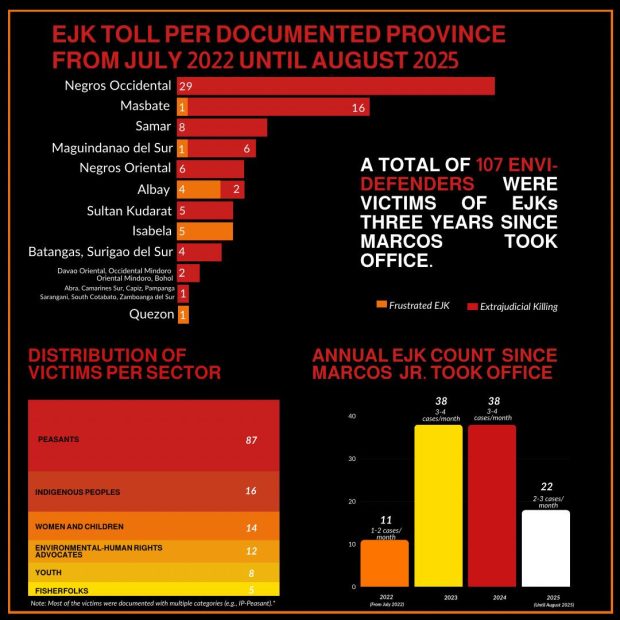
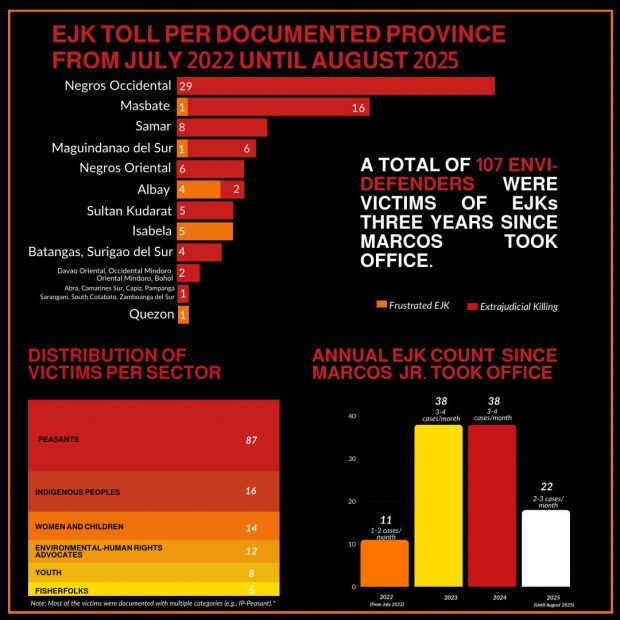
The Ferdinand Marcos Jr. government is one of the deadliest regimes against environmental defenders with 107 killings in less than 42 months, an organization revealed.
The Kalikasan People’s Network for the Environment said the Philippines continues to slide deeper into ecological destruction and human rights crises under Marcos Jr.
“[S]ince Marcos Jr. took office in (July) 2022, there have been at least 107 extrajudicial killings of environmental defenders, 87 of them peasants, 16 Indigenous peoples, and 14 women and children,” the group reported.
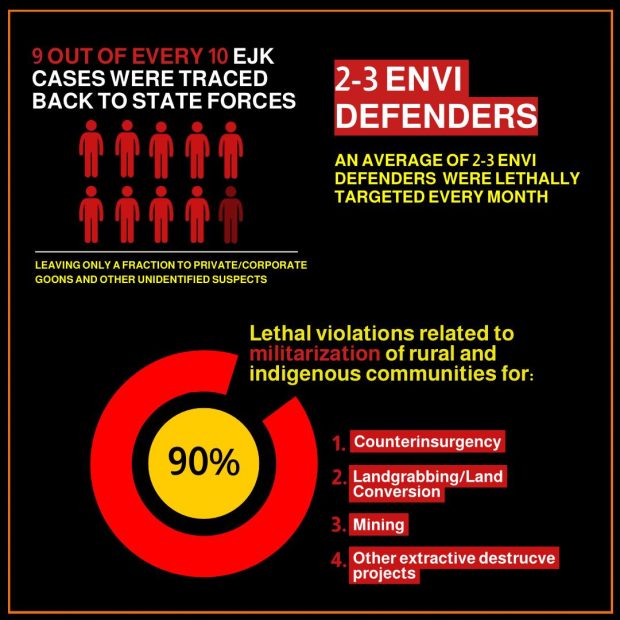
Nearly 90% of these killings have been blamed on State forces, overwhelmingly the military, revealing the Armed Forces of the Philippines’ brutal role in enforcing resource exploitation, it added.
There is an intensified repression tightly linked to the administration’s political and economic interests, which centralizes on resource extraction and investment liberalization while employing militarization and counterinsurgency as tools to silence dissent and thwart the people’s defense of the environment, Kalikasan said.
“These killings follow clear patterns: victims are attacked in rural and Indigenous communities, often while working their farms or foraging food; many cases involve fabricated armed encounters; torture marks have appeared on several victims; and in numerous incidents, soldiers paraded bodies to instill fear among residents,” the group added.
Negros Occidental, already long scarred by agrarian conflict and land monopolies, recorded the highest number of killings with 29 deaths since July 2022 when Marcos Jr. assumed power.
Environmental plunder and militarization
Militarization deepened further in resource-rich territories under the Marcos Jr. government coupled with intensified counterinsurgency deployments, the group’s report reveals.
Military deployments in civilian communities are compounded with the expansion of EDCA (Enhanced Defense Cooperation Agreement, with the United States) sites, transforming forests, ancestral domains, and uplands into militarized zones, it added.
“Communities resisting mining, dams, or land grabs are subjected to surveillance, forced surrenders, coercive ‘community support’ operations, and relentless red-tagging,” Kalikasan said.
In such communities occur assassinations of environment defenders.
In 2023, US-based group Human Rights Watch dubbed the Philippines as the most dangerous country in Asia for environmentalists.
In that year alone, 17 environmentalists have been killed, mostly by suspected State agents.
Ecological defense as crime and insurgency
Kalikasan blames the government’s brutal counter-insurgency operations and government’s self-imposed bid to end the 57 year civil war with the Communist Party of the Philippines and the New People’s Army as contributory to mounting rights violations.
“Marcos Jr.’s refusal to abolish the NTF-ELCAC (National Task Force to End Local Communist Armed Conflict, the government’s counter insurgency mechanism), despite mounting evidence of abuses, signals the regime’s commitment to a security architecture that collates activism into insurgency,” Kalikasan said.
“[T]he persecution of environmental defenders under the Marcos Jr. administration reflects a political order that heavily criminalizes ecological resistance,” Kalikasan said.
“As extractive projects expand and civic spaces narrow, environmental defenders remain on the frontline of both ecological defense and democratic resistance, bearing the full weight of an increasingly repressive state,” the group added
The Philippines is acknowledged as one of the world’s most biodiverse and resource-rich nations with immense forests, fertile agricultural lands, mineral reserves, and rich marine ecosystems.
These riches however make it a target for aggressive exploitation by large corporations, foreign investors and corrupt politicians whose activities are coupled with military presence and killings of civilians.
“As destructive mining, reclamation, fossil fuel expansion, and infrastructure projects advance across the archipelago, those who defend these threatened territories—Indigenous communities, peasants, fisherfolk, and environmental advocates—are facing unprecedented persecution by the state,” Kalikasan complained. # (Raymund B.Villanueva)